Reviewed · TBILISI TOURS
17 Day Private Tour through Georgia
Georgia is a small country with an outsized mix of mountains, monasteries, wine villages, Black Sea resorts, cave towns, and old trading routes. This 17-day private tour connects nearly all of the major regions, from Tbilisi to Ushguli and Batumi, without making you plan a new hotel and route every morning. I especially like the time given to Svaneti and Kakheti, two areas where Georgia feels most distinctive. The drawback is the pace: 2,485 kilometers in 17 days means several long drives and some days that feel more like road trips than leisurely sightseeing.
I also like the built-in free day in Tbilisi and the small maximum group size of 15. Past arrangements have included comfortable 4 and 5-star hotels, private transport, and guides such as Lasha, while Dali has handled detailed trip planning. Still, confirm the exact hotels, vehicle, guide, and included meals before paying, since those details can affect the value of the $4,219 price.
Key points at a glance
- A true cross-country route: You visit Tbilisi, Kakheti, the Greater Caucasus, Kartli, Imereti, Svaneti, Adjara, Samtskhe-Javakheti, and the Black Sea coast.
- Kakheti gives the tour its strongest food and wine focus: Numisi, Twins Wine Cellar, Tsinandali, Gremi, and Sighnaghi all appear in the eastern section.
- Svaneti is the most demanding and rewarding part: Ushguli, Mestia, medieval churches, mountain villages, and a possible walk toward Shkhara Glacier require a full day on rougher mountain roads.
- You get major Georgian monuments in context: Mtskheta, Gergeti Trinity Church, Uplistsikhe, Gelati, Vardzia, and Rabati Castle are all included.
- The tour runs from April through October: That gives you the best stated season for combining high mountain roads, outdoor sites, and the Black Sea coast.
- The package includes 16 overnights and 16 breakfasts: Three dinners, water, taxes, and entrance fees at listed sites are also included.
Tbilisi begins with churches, baths, and old lanes
Your first day is simple: meet at Tbilisi International Airport and transfer to the hotel. That is useful after an international flight, since you can begin the sightseeing the next morning without sorting out a taxi or finding your accommodation.
Day two gives you a full introduction to Tbilisi. Start at Sameba, or the Holy Trinity Cathedral, one of the tallest Orthodox Christian churches in the world. Its scale sets the tone for Georgian religious architecture, but your guide matters here. A good guide can explain the role of Orthodox Christianity in Georgian culture without turning the visit into a string of dates and names.
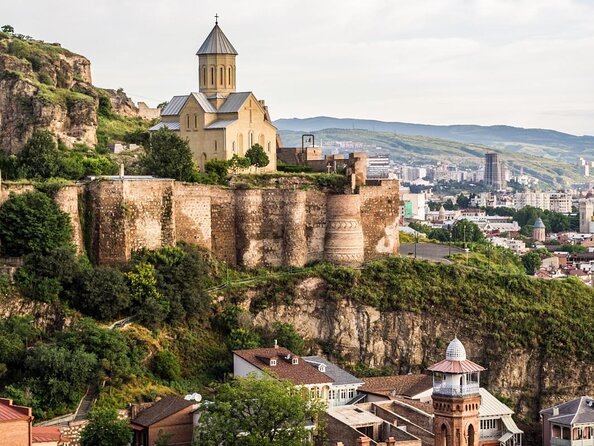
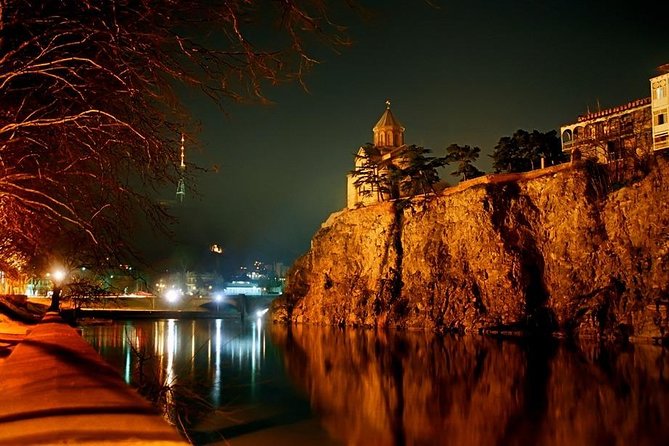
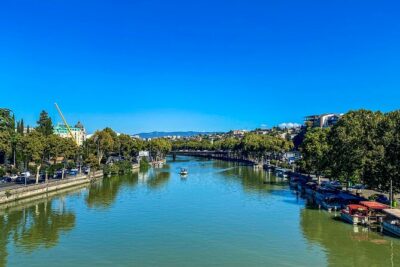
Metekhi Church comes next, perched above the Mtkvari River on Metekhi Plateau. Then you ride the aerial cableway from Rike Park toward Narikala Fortress. The cableway is a practical choice because it saves a steep climb and gives you broad views over the old city.
Narikala dates to the fourth century and once guarded Tbilisi from its hilltop. From there, the route heads downhill through Abanotubani, the sulfur bath district. You pass Legvtakhevi canyon and its waterfall, then continue around Meidan Square and Shardeni Street, where cafes, galleries, and souvenir shops fill the old lanes.
I like this part because it mixes grand monuments with ordinary city texture. You are not only looking at churches and fortifications. You also see the bathhouses, courtyards, narrow streets, and places where Tbilisi’s old center still functions as a neighborhood.
The Tbilisi History Museum and Georgian National Museum add useful background. The first focuses on daily life and culture in the city, with objects reaching back to the Bronze Age. The national museum covers an even longer span, from the Paleolithic period through the medieval era, with archaeological, ethnographic, and artistic collections.
The main caution is time. Six stops make day two busy, and the museums may feel rushed if you prefer to read every display. Use the guide to identify the highlights rather than trying to absorb every object.
more days out of Tbilisi to compare
- Kazbegi and Gudauri Full Day Private Tour from Tbilisi
★ 5.0 · 447 reviews - Old Tbilisi Tour: Private Walking Tour With Wine Tasting
★ 5.0 · 273 reviews - Private Tbilisi Food Tour: 9 Tastings Walk in Bohemian District
★ 5.0 · 227 reviews
David Gareja and the wines of Kakheti
Day three takes you southeast to the semi-desert setting of David Gareja. The sixth-century monastery is cut into the Gareja hills, with cave cells, chapels, living spaces, and churches spread through the rock. Part of the complex lies in Azerbaijan, which adds a modern border issue to an already unusual religious site.
The monastery is free to enter, but the setting is exposed and dry. Bring water, sun protection, and shoes suitable for uneven ground. The tour includes water, but carrying your own bottle remains sensible on a warm day.
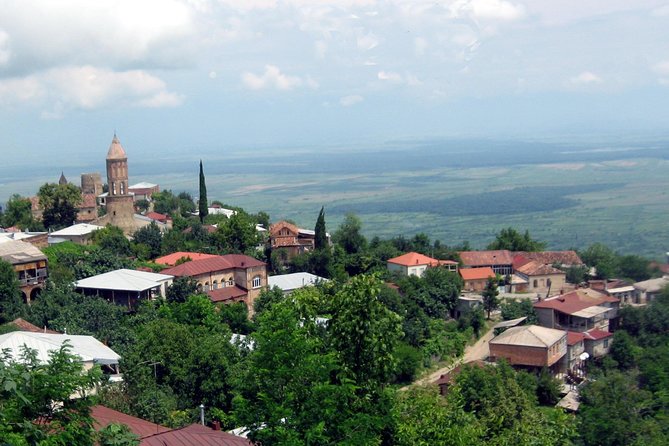
From David Gareja, you continue to Sighnaghi, a compact town on the eastern foothills of the Gombori Range. Its defensive walls and views across the Alazani Valley make it one of Kakheti’s most appealing stops. This is a good place to slow down after the monastery, though the itinerary gives you only about 40 minutes there.
Day four is devoted to Kakheti, Georgia’s main wine-producing area. At Bodbe Monastery, you see a pilgrimage site linked with Saint Nino, who brought Christianity to Georgia. The complex functions as a nunnery, and Saint Nino’s relics are buried there.
The wine stops are especially useful because they show several sides of Georgian winemaking. At Numisi Wine Cellar Museum in Velistsikhe, you visit one of Kakheti’s old cellars. At Twins Wine Cellar in Napareuli, transparent 500-liter vessels let you see stages of production, including pressing, boiling, and natural filtration.
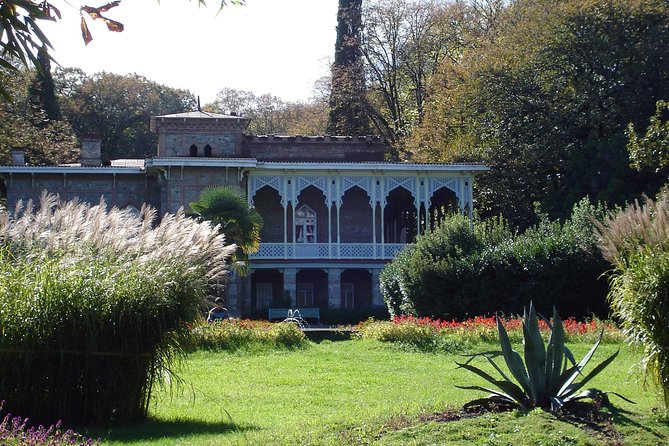
Tsinandali adds a different layer. The former residence of Alexander Chavchavadze includes a house museum, garden, and wine cellar. Chavchavadze was a 19th-century nobleman, poet, military figure, and public personality, so the stop links wine with Georgian literary and political life.
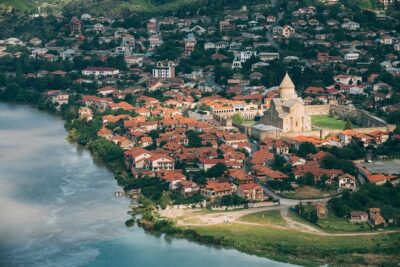
At Gremi, the Church of the Archangels, castle, bell tower, wine cellar, and defensive walls are the remains of a former Kakhetian capital. You finish the day in Telavi. I like the sequence here: monastery, village cellar, estate museum, working wine site, and medieval royal complex. It gives you more than a single tasting room.
The limitation is that the supplied details do not specify how much wine or food is included at each cellar. Ask before departure if tastings, meals, and cellar fees are covered.
Mtskheta and the road into the Caucasus
Day five takes you from Telavi toward Mtskheta, the ancient capital at the meeting point of the Aragvi and Mtkvari rivers. Jvari Monastery and Svetitskhoveli Cathedral are the major draws. Both are UNESCO World Heritage Sites and remain central to Georgian religious life.
Mtskheta is not just a monument stop. Its position helps explain why this place mattered for early Georgian kingdoms and trade routes. You can expect roughly 90 minutes there, followed by Ananuri Fortified Castle Ensemble, which receives about 40 minutes.
Ananuri sits beside the road north and makes a fine pause before the mountain route. The day ends in Gudauri at about 2,196 meters. That altitude is worth noting if you are sensitive to mountain conditions or usually need time to adjust.
Day six is the Caucasus mountain day. You travel through the Cross Pass at 2,395 meters and stop to taste local mineral water before reaching Stepantsminda, also called Kazbegi.
The central walk is to Gergeti Trinity Church. The route is described as easy and takes about two hours, with the church sitting high above town. From the top, you look toward Kazbegi Glacier and Mount Kazbegi, which reaches 5,047 meters.
After returning to town, the route continues to Dariali Gorge and Gveleti waterfalls. This is one of the tour’s strongest combinations of culture and scenery. You get a famous church, a mountain town, a dramatic gorge, and a waterfall in one day.
Still, the walk and mountain roads deserve honest attention. Weather can affect views, and the itinerary does not give a separate bad-weather plan. Ask your guide about road conditions and the exact walking distance before setting out.
Gori, Uplistsikhe, and Kutaisi’s Golden Age
Day seven shifts back toward central Georgia. In Gori, the Stalin Museum explores the life of Joseph Stalin, who was born there. The subject is politically charged, and the museum presents a particular version of his story. I would treat it as a historical stop that requires some thought, not as a simple celebration.
Uplistsikhe is more unusual. This ancient rock-hewn town, with tunnels, chambers, streets, and religious spaces, dates as early as the first millennium BC. Its position and carved rooms show how people used rock as both shelter and city infrastructure long before modern tourism.
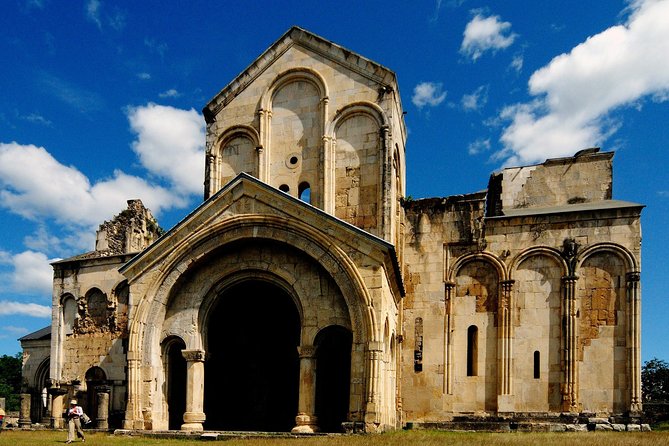
The drive continues west through the Rikoti Pass, with stops at pottery and farmers’ markets. You arrive in Kutaisi for Gelati Academy and Monastery and Bagrati Cathedral, both linked to Georgia’s medieval Golden Age.
The listed visit to Kutaisi’s historic sites takes about two hours and ten minutes. That is enough for a strong overview, but not for long, quiet visits at every building. The day also includes substantial driving, so expect a full schedule.
A different direction out of Tbilisi entirely:
- Day Trip to Kakheti Wine Region Including 9 Wine Tastings
★ 5.0 · 2,774 reviews - Highlights of Caucasus Mountains-Jinvali,Ananuri,Gudauri,Kazbegi(Group tour)
★ 5.0 · 2,682 reviews - Day Trip to Kazbegi and Gudauri
★ 5.0 · 2,009 reviews - Day Trip to Mtskheta Gori and Uplistsikhe
★ 5.0 · 1,801 reviews
Sataplia, Zugdidi, and the first taste of Svaneti
Day eight starts with a Kutaisi market visit, where local farmers sell fruit, vegetables, and Imeretian cheese. This is the kind of short stop that can make a long tour feel more connected to daily life. If you like regional food, ask your guide about the cheese and local produce before moving on.
Sataplia Cave and Nature Reserve combines karst caves, deciduous forest, and preserved dinosaur footprints. It is an easy change from the churches and museums of the previous days, though the tour allows about 90 minutes, so the visit remains fairly focused.
Next comes Zugdidi and the Dadiani Palaces Historical and Architectural Museum. The museum gives you a look at the Dadiani dynasty and the Samegrelo region before the route turns north.
The drive into Svaneti includes a stop at Enguri Dam, one of the world’s highest concrete arch dams. You then arrive in Mestia, the regional center. The road is a major part of the day, but it also marks a real change in Georgia’s character, from western lowlands to high mountain communities.
Ushguli and Svaneti’s stone towers
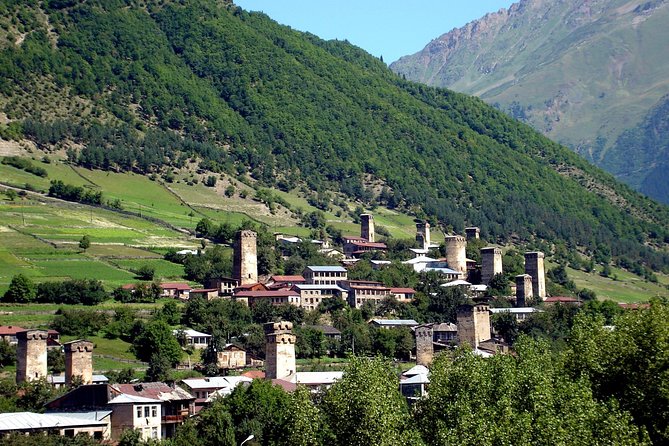
Day nine is the tour’s most distinctive mountain excursion. Ushguli is a community of four villages and one of Europe’s highest continuously inhabited settlements. It is also part of a UNESCO World Heritage area, known for preserved architecture and long-held local customs.
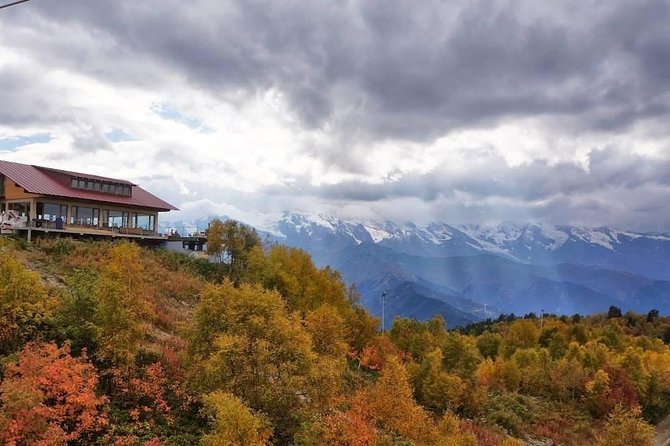
The drive includes stops in Ipari and Kala, where you can see village churches with medieval frescoes and murals. An optional easy walk can take you toward the foothills of Shkhara Glacier, Georgia’s highest mountain peak.
Allow for a demanding day. The schedule gives about four hours to Ushguli, not counting all driving and photo stops. Mountain roads can be slow, and the route may feel rough compared with the paved city sections.
Back in Mestia, Margiani’s House Museum occupies an old Svan housing estate. It presents traditional Svan domestic life through the building itself and its contents. The Svaneti Museum of History and Ethnography appears on day eleven, with manuscripts, icons, and archaeological and ethnographic material.
Day ten is less tightly timed. You visit Latali and Lemjeri, villages near Mestia known for churches with medieval decoration, frescoes, and murals. This is a welcome pause in the itinerary. After several major sites, smaller village churches let you look closely instead of moving from one headline attraction to another.
Batumi and Georgia’s Black Sea side
On day eleven, you leave Svaneti for Batumi, the capital of Adjara and Georgia’s second-largest city. After arrival, you take a short city walk around Piazza Square and along the boulevards.
Batumi changes the mood again. The city is on the Black Sea, and its broad public spaces feel very different from Mestia’s mountain villages. The evening tour lasts about two hours, enough to get oriented before the next day’s excursions.
Gonio Fortress, about 10 kilometers from Batumi, dates to the first century AD. It was a fortified Roman city in ancient Colchis and later came under Byzantine rule. The site connects Georgia’s Black Sea coast with the wider Roman and Byzantine world.
The Batumi Botanical Garden at Green Cape opened in 1912 and includes plants from several climate zones. You have about two hours there, which should allow a pleasant walk, though the garden’s size means you will not see everything.
Batumi is one place where the tour gives you a broad introduction rather than a deep stay. If your priority is beach time or city nightlife, the schedule may feel short. If you want Batumi as one part of a larger national route, the balance works well.
Borjomi, Rabati, and Vardzia
Day thirteen takes you from Batumi to Borjomi, a spa town known for its mineral water. In Borjomi Park, you walk and taste water from the springs. The visit lasts about an hour, so think of it as a stop on the route rather than a spa holiday.
You then continue to Akhaltsikhe in the Samtskhe-Javakheti region. Day fourteen focuses on the area’s layered religious and political past.
Rabati Castle includes a medieval castle, churches, a mosque, a synagogue, and a museum. That mixture is important. It shows how different communities and ruling powers shaped southern Georgia over time. The visit lasts about 90 minutes, giving you enough time to see the main parts without spending the whole day indoors.
Khertvisi Fortress is a brief stop beside the Mtkvari River. The half-hour visit is shorter and focuses on the ruins before you continue to Vardzia.
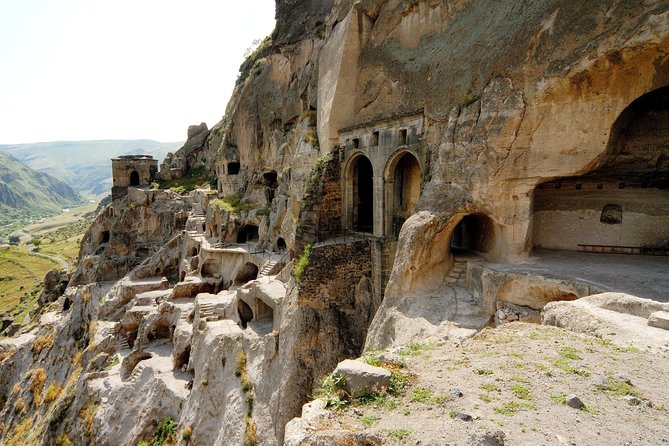
Vardzia is one of Georgia’s great sights. Founded in the 12th century during Queen Tamar’s reign, this rock-cut monastery contains cave dwellings, churches, chapels, and chambers arranged across several levels. The one-hour visit provides a good first look, but uneven surfaces and stairs can make the site tiring for some people.
This section is particularly strong for anyone interested in Georgian architecture and religious sites. It is less suited to someone who wants slow mornings and long meals, since the route keeps moving.
The return to Tbilisi and what the $4,219 covers
Day fifteen returns to Tbilisi across the Javakheti volcanic plateau. Stops include the alpine lakes of Sagamo and Paravani and the large Tsalka reservoir. These pauses break up the drive and show a quieter side of Georgia, far from the main cities and monasteries.
Day sixteen is free in Tbilisi. That matters. You can revisit the old town, shop for wine or crafts, rest after the long route, or add your own museum time. Day seventeen ends with breakfast, check-out, and airport transfer.
At $4,219 per person, the price is not aimed at budget touring. The package includes all taxes and fees, water, 16 nights, 16 breakfasts, three dinners, listed entrance fees, airport transfers, and the service of a professional guide and driver. A private format also gives you more control than a large coach trip, with a maximum group size of 15.
The value depends heavily on the accommodation and transport standard. Past arrangements connected with this operator included 4 and 5-star hotels, comfortable accommodation, private cars, and careful planning by Dali. Confirm that your booking has the same standard, and ask which dinners are included.
The package does not include flights, insurance, visa fees, or meals beyond those specified. The tour is offered from April through October, and confirmation is subject to availability. Most people can participate, but the mountain walks, uneven historic sites, and long drives make basic mobility important.
The cancellation terms are strict close to departure. You can receive a full refund if you cancel at least six full days before the start time, while cancellations two to six days ahead receive 50 percent. Less than two days means no refund.
Who should book this Georgian journey
I would choose this tour if you want to see Georgia broadly and prefer one organized route over arranging regional transport yourself. It suits you especially well if monasteries, mountain villages, wine, archaeology, and local museums all sound appealing.
The strongest parts are Kakheti’s cellar visits, the Caucasus route to Gergeti, and the two days around Mestia and Ushguli. The itinerary also does a good job of reaching places that are awkward to connect independently, especially Svaneti and Vardzia.
I would hesitate if you want a relaxed holiday with few hotel changes, long meals, or several days at the coast. You should also ask for the final hotel list, vehicle details, meal plan, and guide assignment before booking. If the quoted standard matches the comfortable private arrangements previously provided, the cost can make sense for a highly organized, all-country trip. If not, the price deserves closer comparison.
FAQ
How long is the tour?
The tour lasts approximately 17 days, from airport arrival in Tbilisi to airport transfer on the final morning.
Where does the tour start and end?
It starts with pickup at Tbilisi International Airport and ends with a transfer to the same airport.
What is the tour price?
The listed price is $4,219 per person.
What is included in the price?
The package includes all fees and taxes, water, 16 overnight stays, 16 breakfasts, three dinners, and listed admission fees. Airport transfers are also part of the itinerary.
Are flights included?
No. Flight tickets are not included.
When is the best time to take this tour?
The stated operating season is April through October.
How many people can join the tour?
The maximum group size is 15 people. The tour is described as private, with a professional guide and driver.
Does the itinerary include wine regions?
Yes. You visit Kakheti, including Sighnaghi, Numisi Wine Cellar Museum, Tsinandali, Twins Wine Cellar Museum, and Gremi.
What is the cancellation policy?
A full refund is available when you cancel at least six full days before the start time. Cancellation two to six full days before departure receives a 50 percent refund, and cancellation less than two full days before departure is nonrefundable.
Recently added around Tbilisi
- 2-Day Private Wine Tour to Kakheti from Tbilisi★ 5.0 · 3 reviews
- Kakheti wine region – Private Tour★ 5.0 · 3 reviews
- Tbilisi and Mtskheta cities private, cultural tour★ 5.0 · 3 reviews
- Tbilisi City Tour with Street Photography★ 5.0 · 3 reviews
- Kakheti With Top Destinations★ 5.0 · 3 reviews
- Tbilisi City, Jvari Monastery, Uplistsikhe caves, Mtskheta city Private Day Trip★ 4.5 · 3 reviews
- Jvari monastery & Mtskheta – Half day group tour from Tbilisi★ 5.0 · 3 reviews
- Instagrammable sites of Tbilisi private tour★ 5.0 · 3 reviews
Tbilisi Tours, compared.
Day Trip to Kakheti Wine Region Including 9 Wine Tastings
Read our review →
Highlights of Caucasus Mountains-Jinvali,Ananuri,Gudauri,Kazbegi(Group tour)
Read our review →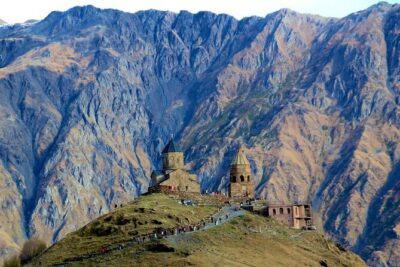
Tbilisi Walking Tour Including Cable Car and Traditional Bakery
Read our review →
Kakheti Wine Region: Signagi and Bodbe Tour with 10 Wine Tastings
Read our review →