
Reviewed · KUTAISI TOURS
Day Tour to Georgian sky venice, Soviet city Chiatura
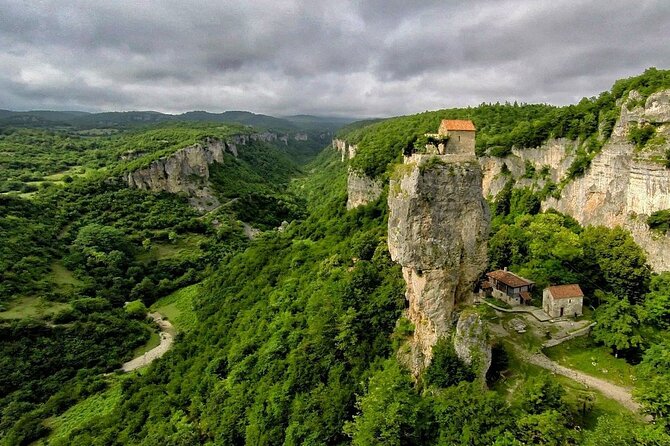
Chiatura is one of Georgia’s strangest and most memorable day trips. This former mining town still carries the look of a Soviet industrial city, while nearby Katskhi Pillar rises like a stone tower with a monk living at the top. Add a rock-cut monastery and a small local museum, and you get a full day with plenty of character.
I like the private pickup from anywhere in Kutaisi, including hotels and airports, and I like the human touch of guides such as Shota and Tornike, who explain Georgian life rather than simply point at buildings. The main consideration is that admission fees for Katskhi Pillar and the museum are not included, and women cannot climb to the monk’s dwelling on the pillar.
Key points to know before you book
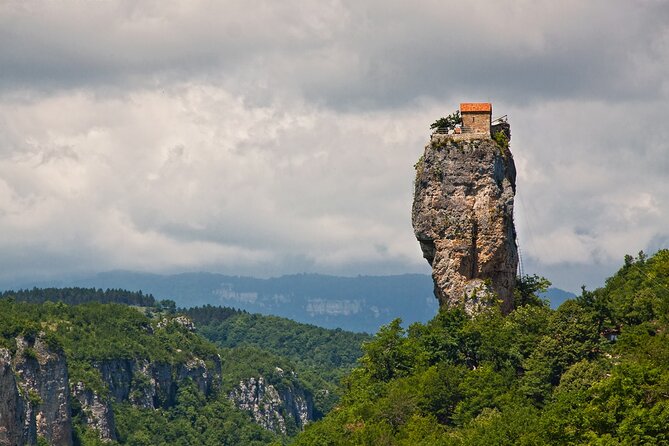
- Katskhi Pillar is a 40-meter natural monument with a small religious community limited to one monk at the top.
- Chiatura gives you a rare look at Soviet-era urban Georgia, shaped by mining and dramatic hills.
- Mgvimevi Monastery is partly carved into rock and includes a 13th-century two-nave basilica.
- The tour is private, so only your own group takes part.
- Pickup and return are arranged in Kutaisi, including hotels and airports.
- Shota and Tornike are named guides associated with the experience, with a focus on stories, local life and flexible stops.
Why Chiatura makes such a memorable day from Kutaisi
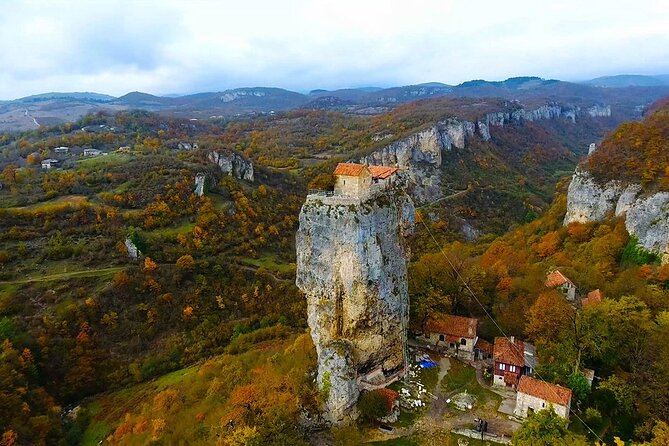
Many day trips from Kutaisi focus on grand churches, caves or waterfalls. This one takes a different route. It brings you to Chiatura, a town shaped by mining and Soviet planning, then adds two very different religious sites: Katskhi Pillar and Mgvimevi Monastery.
That contrast is the real strength of the outing. You move from a natural stone column with a monk’s tiny world at its summit to a town of old industrial buildings and transport systems, then to a quiet Orthodox monastery cut partly into the rock. The places do not feel arranged for tourists. They feel like pieces of western Georgia’s everyday past and present.
The tour lasts about 6 to 7 hours, which gives you enough time for the main stops without turning the day into a long expedition. Since it is private, you are not sharing the vehicle or schedule with strangers. That matters here because Chiatura is best understood through questions and conversation. Guides Shota and Tornike are specifically associated with the tour, and their role includes explaining Georgian life and helping shape the day around your interests.
more soviet-era sites to see
- Kutaisi:Chiatura Tour with Katskhi Pillar & Cable Car Experience
★ 5.0 · 95 reviews - Tskhaltubo Old Soviet Spa Tour
★ 4.5 · 12 reviews - Kutaisi: Chiatura Cable Cars & Katskhi Pillar Guided Tour
★ 5.0 · 8 reviews
Katskhi Pillar, a stairway to a monk’s world
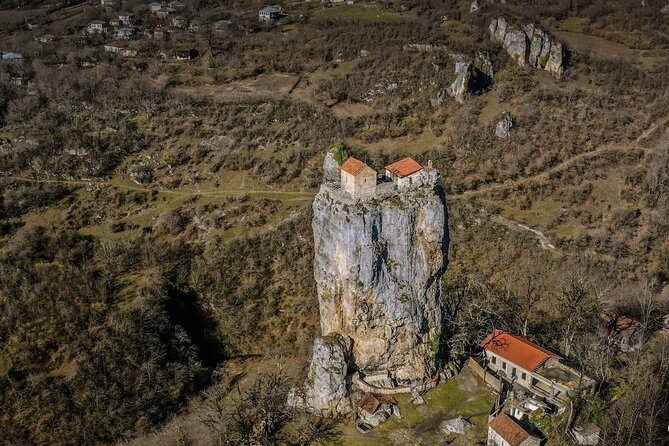
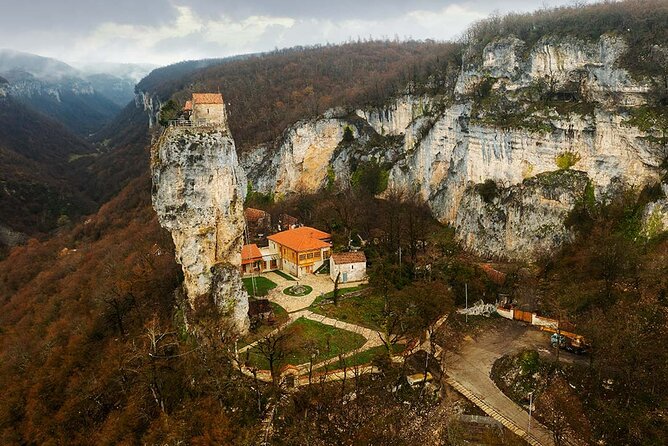
The first major stop is Katskhi Pillar, located about 13.4 kilometers from Chiatura. The stone column rises roughly 40 meters above the ground. From below, it looks almost too narrow and steep to support a chapel or dwelling, which explains its local nickname as a stairway to heaven.
Only one monk lives at the top. The silence and isolation are central to the place, not minor details. The religious meaning comes from the sense of separation, with the monk living high above the surrounding area rather than beside a road or in a busy settlement.
You should know the access limits before you arrive. Women are not allowed to climb to the top, so this is primarily a viewing stop for many visitors. The tour description does not promise a climb for men either, and you should treat the pillar as a site to see and understand from below unless your guide confirms otherwise.
The stop lasts around 40 minutes. That is enough time to take in the column, hear its story and appreciate how unusual the setting is. Admission is not included, so budget for a separate fee if one applies on the day.
I like this stop because it is not just another church visit. The physical setting does much of the talking. A solitary monk, a high stone column and the rule that keeps the top inaccessible to women give Katskhi Pillar a strong sense of mystery without requiring a long explanation.
Chiatura and its Soviet industrial character
Chiatura is the heart of the excursion. The town is known for its mining past and Soviet-era character, and it can feel very different from the polished streets and restored churches of Kutaisi. The surrounding hills press close to the urban area, while older buildings and industrial traces create a visual record of another period.
The town’s appeal is not conventional beauty. You come here to see a place where work, transport and city planning were shaped by mining. Its worn appearance is part of the story. You may notice old structures, steep routes and the kind of urban setting that feels more functional than decorative.
A private tour works well in Chiatura because the guide can add context as you move around. Shota and Tornike are described as guides who share stories about Georgian life, and that broader conversation is useful here. Without explanation, the town may seem like a collection of aging buildings. With context, it becomes a place connected to industry, labor and the Soviet period.
One review describes Chiatura as the most Soviet town encountered on a wider Georgian trip. That is a useful expectation setter. Do not come looking for a fully restored historic center. Come for atmosphere, contrast and a direct look at a Georgian town whose identity was formed by mining.
A small museum with ancient finds and old photographs
The Chiaturi Local Museum gives the day a historical anchor. The collection includes archaeological materials found in the area, including items dated to the third millennium BC, along with antique cameras and old photographs of Chiatura.
That mix is especially useful because it connects two timelines. The archaeological objects point to the area’s distant past, while the cameras and photographs show how Chiatura looked in more recent decades. You get a sense of both the people who lived in the region long ago and the town that developed around modern industry.
The museum visit takes about one hour. Admission is not included, so check the entry cost when booking or with the guide. Since local museums can vary in opening arrangements, your guide is the right person to ask about practical details on the day.
I would not treat this as a large national museum with room after room of major collections. Its value is more local and focused. The old photographs may be especially helpful after seeing Chiatura itself, since they allow you to compare the present town with earlier views.
For you, the key question is how much you enjoy small museums. If you like archaeology, local photography and places that explain a town rather than simply display famous objects, this hour adds real value. If you prefer outdoor sights only, it will be the quieter part of the day.
more city tours in Kutaisi
- Kutaisi city tour
★ 5.0 · 5 reviews - Kakheti;City of Love Sighnaghi, Bodbe. KTW. Wine House Group tour
★ 5.0 · 376 reviews - Tbilisi: Old and New City Guided Tour with 2 Cable Car Rides
★ 5.0 · 176 reviews - City tour Tbilisi on red bus
★ 4.5 · 139 reviews
Mgvimevi Monastery, part church and part cave
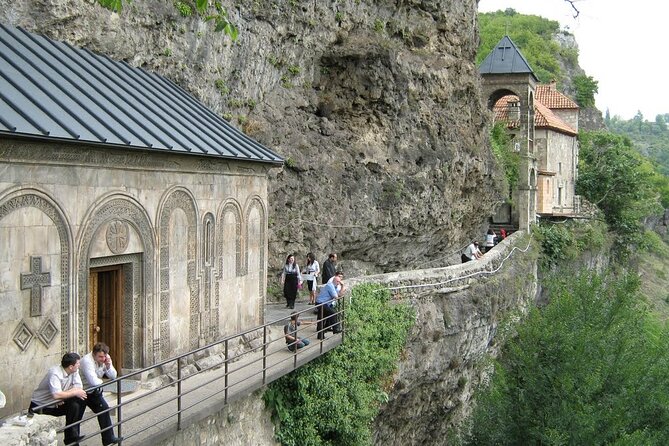
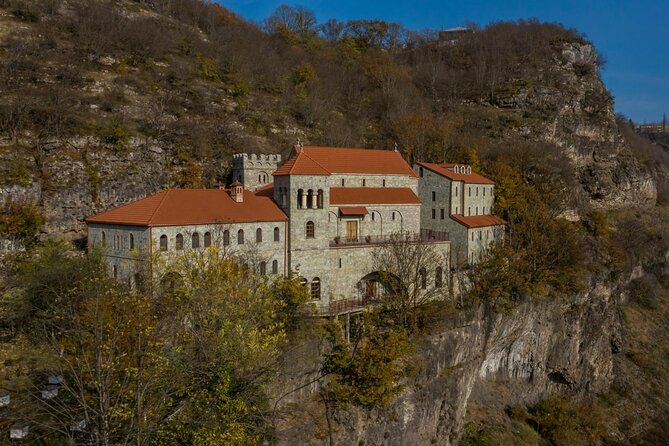
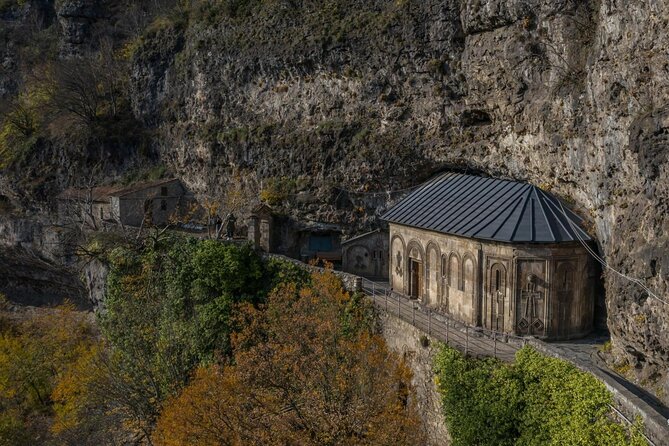
Mgvimevi Monastery is one of the most distinctive stops. Located near Chiatura, the complex is partly carved into rock and functions as a Georgian Orthodox nunnery. Its main church is a 13th-century two-nave basilica dedicated to the Nativity of the Mother of God.
The complex also includes a smaller hall church, a bell tower and a surrounding wall. Ornamental stone carving decorates the exterior, giving you details to look at beyond the dramatic rock setting. The monastery is listed among Georgia’s immovable cultural monuments of national significance.
The visit lasts about one hour and admission is free. That makes it a good counterpoint to the museum and Katskhi Pillar. At the pillar, the religious experience is distant and vertical. At Mgvimevi, you can spend time with the architecture, the rock-cut spaces and the continuing life of a functioning religious community.
Dress and behavior should be respectful, as you are visiting an active nunnery rather than an abandoned monument. The supplied information does not list a formal dress code, so your guide can advise you if any local expectations apply.
I like Mgvimevi because it brings together geology, worship and architecture in a compact setting. It also keeps the tour from being only about Soviet Chiatura. You see a much older Georgian religious tradition still present near the town.
What the private format changes
The private format is one of the strongest practical features. Only your group participates, which means you do not have to match the pace of a large coach party or wait for a crowd to finish at each stop.
Pickup is offered anywhere in Kutaisi, including hotels and airports. That removes the need to find a fixed meeting point, which is helpful if you arrive in Kutaisi by air or are staying outside the central area. The tour also returns to Kutaisi at the end.
The private setup can make the day more personal. A guide such as Shota or Tornike can answer questions about Georgian life, explain what you are seeing and, when possible, adjust the route. One account describes stopping at additional places on the way back because the group wanted to see them. That suggests some room for flexibility, but you should confirm any extra stops directly with the provider rather than assume they are included.
The tour is offered in English. Service animals are allowed, and the experience is near public transportation, though the pickup arrangement means you may not need to use it. Most people can participate according to the supplied information.
The value of the $80 price
At $80 per person, this is not the cheapest way to visit Chiatura, especially if you are traveling alone. Yet the price includes private transportation, pickup and return within Kutaisi, an English-speaking guide, and a route that combines several sites rather than taking you to Chiatura alone.
The value improves for two or more people sharing the private experience. Group discounts are offered, so check the current rate for your party. You also avoid arranging separate transport to Katskhi Pillar, Chiatura and Mgvimevi Monastery, which could be difficult if you do not have a car.
Remember that admission to Katskhi Pillar and the Chiaturi Local Museum is not included. Mgvimevi Monastery and the Kutaisi pickup and return are listed as free. The extra entry costs are not the main price issue, but you should carry some money for them.
The other part of the value is guidance. Chiatura is not a simple landmark that explains itself. A good guide helps connect its industrial appearance to Georgian life, while also giving meaning to the pillar, the museum and the monastery. The strongest praise attached to this experience goes to Shota and Tornike for their personal attention, stories and willingness to make the day feel less fixed.
Timing, comfort and who should book
Six to seven hours is a sensible length for this route. You get a substantial day outside Kutaisi without committing to a full-day trip that runs late into the evening. The itinerary includes roughly 30 minutes at the starting and ending points, 40 minutes at Katskhi Pillar, and about one hour each at the museum and monastery, with travel time between them.
You should be comfortable with a varied day. The experience includes driving, outdoor viewing, a museum visit and a religious site. The information does not provide a detailed breakdown of walking surfaces or vehicle type, so ask the provider if you have mobility concerns.
I would recommend this tour to you if you want more than Georgia’s best-known churches and natural sights. It suits people interested in Soviet history, unusual religious sites, local museums and guided conversation. It is also a good choice if you value door-to-door pickup and do not want to plan regional transport yourself.
You may prefer another outing if your priority is a relaxed food tour, a long nature walk or a major museum with a large collection. Chiatura’s appeal is specific. Its worn Soviet character is part of the experience, not a flaw to be hidden.
At the end, the guide can recommend Kutaisi restaurants serving traditional Georgian dishes. That is a useful finish after a long day, especially if you want advice beyond the usual tourist addresses.
Cancellation and booking details
You can cancel for a full refund up to 24 hours before the experience begins. Changes or cancellations made less than 24 hours before the start time are not accepted for a refund, and the cut-off follows local Georgian time.
Confirmation is provided when you book. Pickup is available from any location in Kutaisi, including hotels and airports, so include your exact location when arranging the tour. The provider is Tripify.
Should you book this Chiatura day tour?
Book it if you want a private, story-led look at one of Georgia’s most unusual towns. The combination of Katskhi Pillar, Soviet Chiatura and Mgvimevi Monastery is hard to reproduce in a simple self-guided day from Kutaisi, and the named guides Shota and Tornike add a personal element that suits this kind of place.
The main reasons to hesitate are the separate admission fees, the access restriction at Katskhi Pillar and the fact that Chiatura is intentionally rough around the edges. If that sounds interesting rather than disappointing, the $80 price is reasonable for private pickup, transport, English guidance and a full 6 to 7-hour route.
FAQ
Where does the tour start?
The tour starts in Kutaisi, and pickup is available from any location in the city.
Can I be picked up from my hotel?
Yes. Pickup is offered from hotels in Kutaisi.
Is airport pickup available?
Yes. The tour provider can pick you up from airports in Kutaisi.
How long does the tour last?
The tour lasts approximately 6 to 7 hours.
Is the tour private?
Yes. Only your own group participates in the activity.
What language is the tour offered in?
The tour is offered in English.
How much does the tour cost?
The listed price is $80 per person. Group discounts are available.
Is admission included at every stop?
No. Admission to Katskhi Pillar and Chiaturi Local Museum is not included. Mgvimevi Monastery has no admission charge listed.
Can women climb Katskhi Pillar?
No. Women are not allowed to climb to the top of Katskhi Pillar.
What is the cancellation policy?
You can cancel up to 24 hours before the start time for a full refund. Cancellations or changes made less than 24 hours before the start time are not accepted for a refund.
Recently added around Kutaisi
- Kutaisi Airport to Tbilisi Private Transfer★ 5.0 · 3 reviews
- Oxygen Paradise A Day Tour to Racha Mountain★ 5.0 · 3 reviews
- Private Organic Wine Tour from Kutaisi, 2 Tastings and Lunch★ 5.0 · 3 reviews
- Private Canyon&Cave Tour from Kutaisi(Martvili-Okatse-Prometheus)★ 5.0 · 3 reviews
- Causacus mountains at Majestic SVANETI and MESTIA from Kutaisi★ 4.5 · 4 reviews
- Break Bread with Kutaisi Locals★ 5.0 · 4 reviews
- Small group tour to Kutaisi monasteries: Gelati, Motsameta and Bagrati.★ 5.0 · 4 reviews
- KUTAISI-TBILISI Shared Transfer★ 5.0 · 4 reviews
Kutaisi Tours, compared.
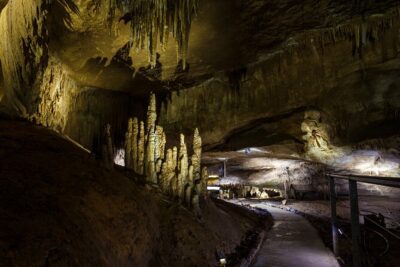
CANYONS & CAVE Tour from Kutaisi – Okatse, Martvili & Prometheus
Read our review →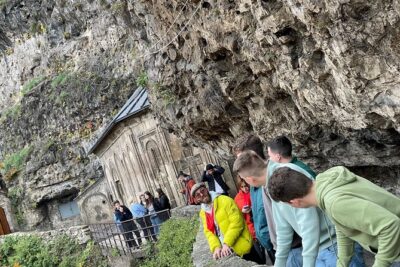
Chiatura Tour with Katskhi Pillar & Cable Car Experience
Read our review →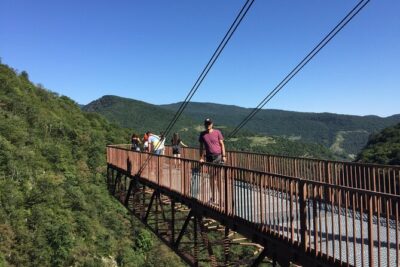
Martvili Canyon & Prometheus Cave, Georgian Lunch
Read our review →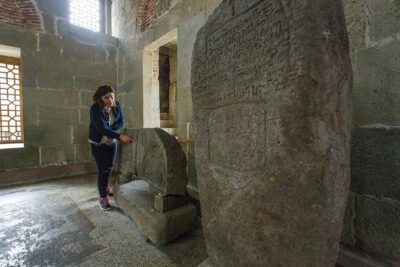
BORJOMI, RABATI & VARDZIA – Group Tour from Kutaisi
Read our review →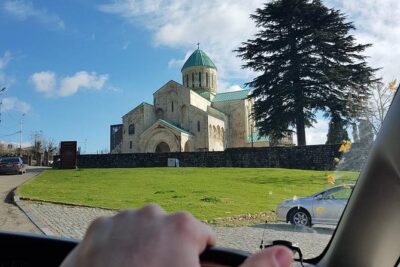
BAGRATI, GELATI & MOTSAMETA Group Tour from Kutaisi
Read our review →
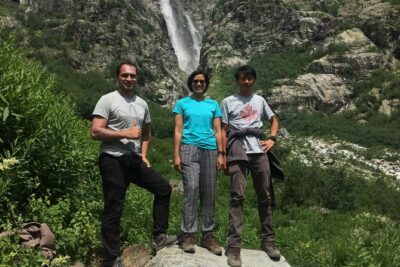
Svaneti Mountain Villages 4×4 Safari, tour from Kutaisi
Read our review →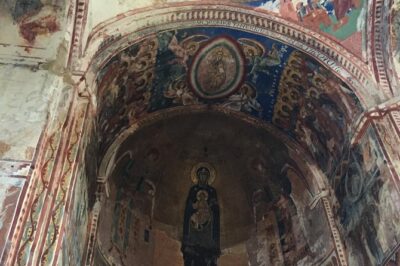
Browse the lists this tour appears in