

Reviewed · TBILISI TOURS
Private Walking Tbilisi City Tour
Tbilisi reveals itself best on foot, where a church courtyard, a hot-spring district, and a tiny waterfall can appear within minutes of one another. This four-hour private tour connects the city’s major sights with the kind of local explanation that helps the old streets make sense.
I like the cable-car ride to Mother of Georgia, which gives you a fine first look at the Mtkvari River and the Old Town. I also like the small scale: your own group can ask questions, pause for photos, or request a slight change, something guides such as Luka, Kate, Nico, Mariam, Sally, and David have done well.
The main consideration is value. At $45 per person, this is fair for private guiding, hotel transfers, and the cable car, but it is not the best pick if you want to cover far-flung parts of Tbilisi by vehicle. One four-star assessment felt a car tour would offer more ground for the money.
Key points at a glance
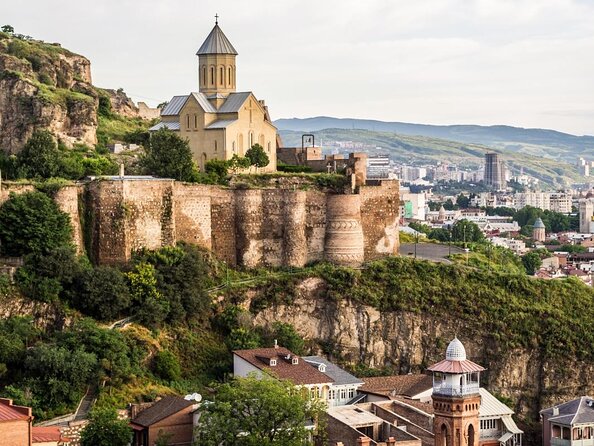
- A useful first look at Old Tbilisi: The route links Metekhi, Rike Park, the historic center, Sioni Cathedral, Abanotubani, and the waterfall.
- The cable car adds real value: You ride from Rike Park toward the Mother of Georgia statue for broad city views.
- Private guiding keeps the pace flexible: Guides can answer questions, take photos, and make small adjustments for your group.
- Expect plenty of history and church stops: Metekhi, Anchiskhati, and Sioni each show a different part of Georgian religious and civic history.
- The finish is atmospheric: Sulfur baths, narrow lanes, the Tamada statue, and Leghvtakhevi Waterfall give the walk a local feel.
- Dress for churches and weather: Women need to cover their heads, shorts are not allowed inside churches, and the cable car may stop in strong wind.
Why this route works as a first day in Tbilisi
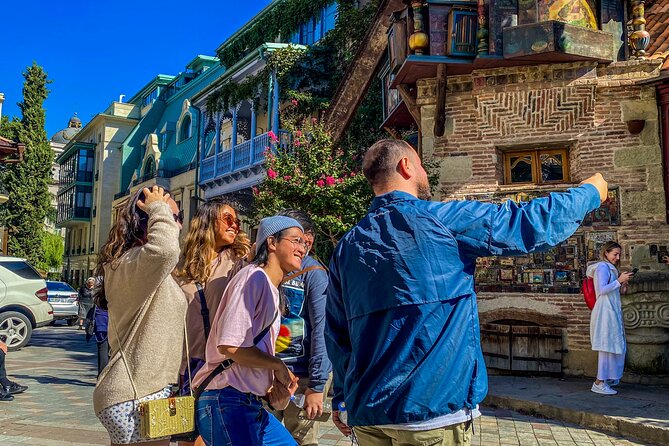
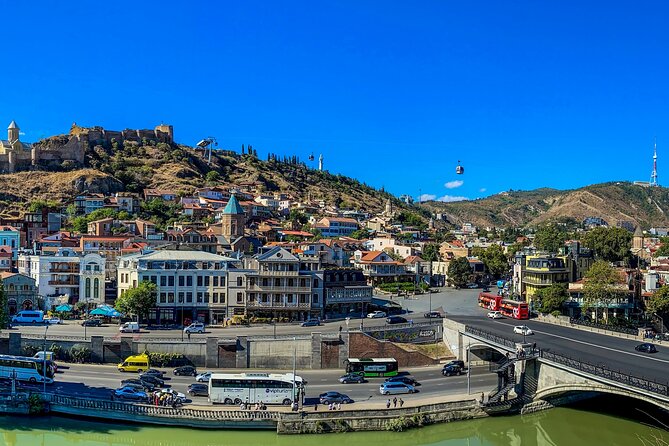
This tour is built around connection rather than distance. You begin near the river, rise above the Old Town by cable car, then walk downhill and through the historic center toward the sulfur baths and waterfall.
That order is smart. The high viewpoint gives you a mental map before you enter the maze of streets. Later, when your guide points out churches, bridges, bathhouses, and hilltop monuments, you can place them in relation to one another.
The private format matters here. Tbilisi is not hard to visit, but its stories can be hard to spot. A guide can explain why King Vakhtang Gorgasali matters, what the Mother of Georgia statue symbolizes, and why sulfur water shaped the city’s name and growth.
The tour is offered in English and includes hotel pickup and drop-off. That makes it a simple choice for a first afternoon, especially if you have just arrived and do not want to work out the city’s layout on your own.
The listed stops add up to roughly two hours of scheduled visits, while the full experience lasts about four hours. The difference allows for walking between sites, the cable car, explanations, photographs, and the natural pauses that come with a private tour. Expect a steady outing, not four hours of nonstop marching.
more walking tours in Tbilisi
- Tbilisi Walking Tour Including Cable Car and Traditional Bakery
★ 5.0 · 1,310 reviews - Tbilisi:Evening Walking & Talking Tour with Wine & Boat Ride
★ 5.0 · 572 reviews - Old Tbilisi Highlights walking tour with wine & 10 tastings
★ 5.0 · 276 reviews
Meeting the guide and beginning near Metekhi
Your guide meets you at your hotel reception. The day begins at the Traveler’s Meeting Point, a casual social space with board games, music, and wine. It is a short ten-minute introduction, but it can make the start feel less formal.
From there, you reach Metekhi Cathedral on the left bank of the Mtkvari River. The church sits on a cliff plateau, one of Tbilisi’s most memorable settings for a place of worship. The first church here is traditionally linked with Vakhtang Gorgasali, and local tradition also connects the site with Saint Shushanik.
You receive about fifteen minutes at the cathedral. That is enough for an explanation and photographs, though not a long private meditation or a detailed study of every architectural feature.
Nearby, the monument to King Vakhtang Gorgasali gives the early part of the tour a clear historical anchor. He ruled Iberia, known locally as Kartli, in the late fifth and early sixth centuries. Tradition credits him with founding Tbilisi and reorganizing the Georgian Orthodox Church, although the exact dates of his reign remain debated.
That small detail is worth hearing. It reminds you that Georgian history is not a single polished story. It includes written records, oral tradition, religious memory, and long struggles between regional powers.
Rike Park and the ride above the river
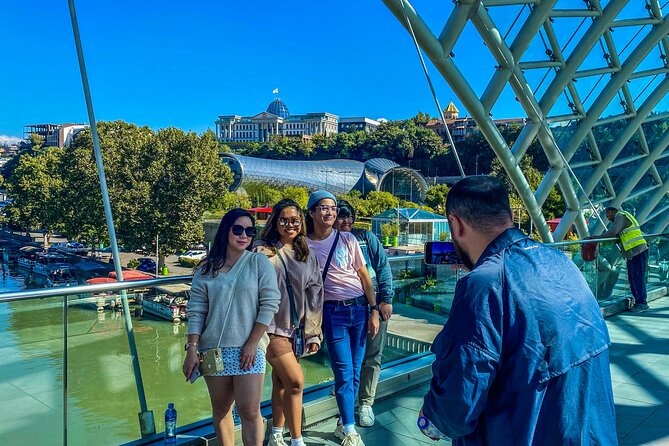
The route continues across Europe Square and into Rike Park, a modern recreation area on the left bank of the river. The square offers a chance to hear about Georgia’s relationship with the European Union, a subject of real importance in the country.
Rike Park is easy to recognize. Its entrance is near the glass-and-steel Bridge of Peace, and the park includes fountains, climbing walls, a children’s maze, large chess boards, paths, bars, and restaurants. You do not spend long here, but the stop helps you see the contrast between old Tbilisi and its newer public spaces.
The cable car leaves from Rike Park. The ride to the upper station takes about ten minutes and is included in the price. This is one of the strongest parts of the outing because you gain height without a strenuous climb, then look back over the river and the clustered roofs of the city.
Wind can stop the cable car. The tour still operates in poor weather, so you should dress for the forecast and understand that this part may not run in strong winds. There is no stated replacement for the ride, so it is sensible to treat the views as a welcome bonus rather than the only reason to book.
Mother of Georgia and Tbilisi from above

At the top, you visit Kartlis Deda, usually called Mother of Georgia. The twenty-meter aluminum statue was created by sculptor Elguja Amashukeli in 1958, when Tbilisi marked its 1,500th anniversary.
The figure wears Georgian national dress. In one hand she holds a bowl of wine for friends. In the other she holds a sword for enemies. It is a compact symbol of Georgian hospitality and self-protection, two ideas that your guide can tie to the country’s long and difficult past.
You have about ten minutes at the statue. The stop is brief, but the setting does much of the work. From here, you can see why Tbilisi feels both enclosed by hills and open toward the river valley.
After the statue, the tour returns toward the center, including the Bridge of Peace. Opened in 2010, this pedestrian bridge has a curved glass-and-steel design and more than 10,000 LED bulbs. The structure arrived from Italy in 200 unassembled pieces.
It is a modern landmark that some people find striking and others find a little loud beside the older city. I think it is useful to see because it captures Tbilisi’s mix of historic buildings and bold recent architecture. You cross it on foot, so this is also a good spot for photographs.
more days out of Tbilisi to compare
- Kazbegi and Gudauri Full Day Private Tour from Tbilisi
★ 5.0 · 447 reviews - Old Tbilisi Tour: Private Walking Tour With Wine Tasting
★ 5.0 · 273 reviews - Private Tbilisi Food Tour: 9 Tastings Walk in Bohemian District
★ 5.0 · 227 reviews - Full Day Private Wine Tour in Kakheti Region with Lunch and 3 Wine Tastings
★ 5.0 · 207 reviews
Old Tbilisi’s churches and small surprises
The next stretch is packed with stops. At the Patriarchate of Georgia, your guide shares facts about the institution and its place in Georgian life. The visit is short, so think of it as a conversation point rather than a full tour.
Anchiskhati Basilica offers more time and a stronger sense of age. The church dates to the sixth century and is linked to Dachi Ujarmeli. It was first associated with the Nativity of the Virgin Mary.
The name Anchiskhati came later, after an icon from the Anchi church was moved here in 1675. That story opens a window onto Georgia’s tradition of icons, church stewardship, and religious art. The basilica is a good reason to keep the tour focused on the center rather than trying to race across the whole city.
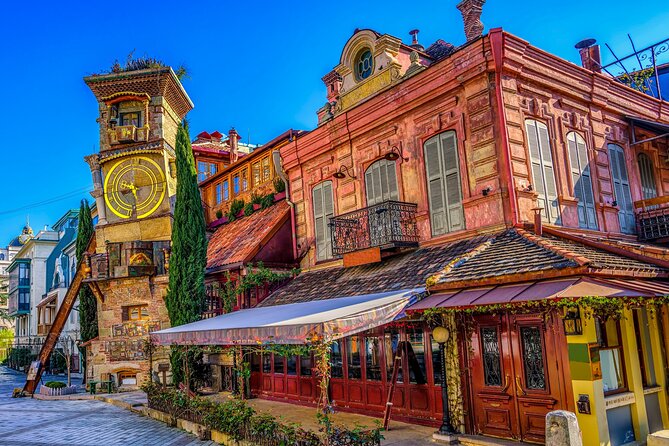
Near the basilica, Rezo Gabriadze’s Marionette Theater and its unusual clock tower provide a change of mood. The tower is decorated with hundreds of tiles designed by Gabriadze. Each hour, an angel appears with a small hammer to ring the bell, and a small puppet performance called The Circle of Life takes place twice daily, at noon and 7 p.m.
The walking tour does not promise that you will see the performance. Your guide can point out the timing, but the route may not line up with it. Even without the show, the tower is one of Tbilisi’s most memorable small sights.
Sioni Cathedral, tamada culture, and Shardeni Street
Sioni Cathedral sits on the street of the same name in Upper Kala, one of the city’s oldest districts. Tradition places an early church here in the time of Vakhtang Gorgasali.
This is another short stop, with about ten minutes for an explanation and a look around. Because several religious buildings appear on the route, you should not expect a full architectural lecture at each one. The advantage is variety: you see several sacred sites while also learning how they fit into the city’s older neighborhoods.
The Tamada statue introduces a different Georgian tradition. A tamada is the toastmaster at a Georgian feast, responsible for guiding the sequence of toasts and helping set the tone of the meal.
This is one of the more useful cultural stops because it connects a statue to something you may encounter later at a restaurant or family table. Ask your guide about the custom if you want more than the short explanation included in the standard route.
Jan Shardeni Street is a pedestrian lane lined with restaurants and city life. It is popular and polished, so it does not feel like the quietest corner of the Old Town. Still, it gives you a convenient look at the part of central Tbilisi built for evening walks, meals, and drinks.
Past guides have added local touches such as wine tasting, Georgian bread, and lemonade, but these extras are not listed among the formal inclusions. If they matter to you, confirm them before booking rather than assuming they are guaranteed.
Sulfur baths and Leghvtakhevi Waterfall

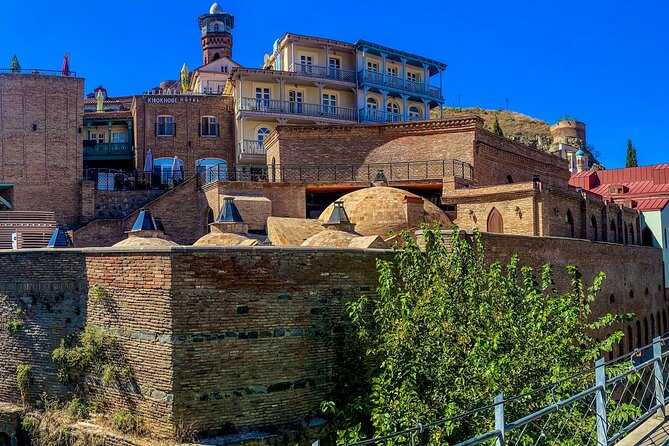
The tour ends in Abanotubani, the sulfur-bath district. Public bathhouses use hot water from the area’s natural sulfur springs, and the bathhouses are among the clearest reminders of how the city’s natural setting shaped daily life.
You spend only about five minutes at the district on the stated route. That is enough to see the domed bathhouse roofs, hear how the springs are used, and decide if you want to return for a separate bath experience.
From there, you walk to Leghvtakhevi Waterfall. The waterfall is a pleasant surprise in the middle of the city, reached through a narrow gorge in the Old Town. The stop is short, but it gives the final part of the tour a cooler, quieter feel.
The waterfall area can be popular on warm days. You might find it less peaceful than the word waterfall suggests, but it remains an unusual final stop and a good place for photographs.
This ending also shows why walking is the right way to experience this portion of Tbilisi. A vehicle could take you close to the district, but it would not give you the same sense of how quickly the city shifts from riverfront streets to churches, bathhouses, and a natural gorge.
What $45 per person really buys you
The price is $45 per person. For that amount, you receive a private English-speaking guide, hotel pickup, hotel drop-off, the cable-car ride, and online support. Gratuities are not included.
For one or two people, the cost is higher than joining a large group walk. You are paying for personal attention, transport at the start and finish, and the ability to ask for small changes. Several guides, including David, Mariam, Nico, and Roma, have been praised for clear explanations, friendliness, and adapting the route to personal needs.
The private setup is especially useful if you want to slow down at a church, ask many questions, or request help with photographs. One guide was specifically praised for taking photos when asked, while others were noted for adjusting the tour to suit the group.
For families or larger groups, group discounts may improve the value. The tour is also easier to justify if you are new to Tbilisi and want a strong orientation before exploring alone.
The less convincing case is for someone who wants maximum coverage. A four-hour car tour can reach places beyond the Old Town, while this experience stays focused on the central sights. You also pay for several short stops, so anyone who prefers long museum visits or extended time at one monument may find the pace too scattered.
Weather, clothing, and church etiquette
The tour runs in all weather conditions. Wear shoes suited to a long city walk and dress for rain, heat, or cold as needed. The cable car may not operate in windy weather.
Church clothing rules are clear. Shorts are not allowed inside a church, and women need to cover their heads. Plan ahead so you do not have to skip one of the main stops.
The tour is private, and most people can participate. No special physical restrictions are stated, but you should be comfortable walking between sites and spending several hours outdoors. The route includes a cable-car ride rather than a climb to the Mother of Georgia statue, which helps reduce the effort at that point.
Free cancellation is available up to 24 hours before the start time for a full refund. Changes or cancellations made within 24 hours are not accepted for a refund, and the cut-off follows local Tbilisi time.
Who should book this Tbilisi walk?
I would choose this tour for a first visit, a short stay, or an arrival day when you want hotel pickup and a clear introduction without planning every turn. It suits couples, families, and small private groups that prefer conversation over a fixed large-group script.
It is also a good fit if you care about Georgian history and Orthodox churches but want those subjects mixed with street scenes, viewpoints, food culture, and a waterfall. The strongest guides bring the city to life through stories, humor, and answers to your questions. Nino, David, Luka, Sally, Kate, Nico, Mariam, Roma, Nika, Oki, and Magda have all been associated with especially positive experiences, though your assigned guide may be different.
I would think twice if you want museums, long interior visits, or a broad tour of modern Tbilisi. The route is dense, and some stops last only five minutes. At $45, it is good value when you want private attention and included transfers, but less so if you simply want the cheapest way to see the Old Town.
Should you book the Private Walking Tbilisi City Tour?
Book it if you want a friendly, private introduction to Tbilisi’s central sights, with the cable car and hotel transfers taken care of. The mix of Metekhi Cathedral, Mother of Georgia, old churches, the Bridge of Peace, sulfur baths, and Leghvtakhevi Waterfall gives you a useful first chapter of the city.
Skip it in favor of a vehicle-based tour if covering more ground matters more than walking through the Old Town. For most first-time visitors who value a flexible guide and a well-shaped four-hour route, this is a sensible starting point, especially if you can use a group discount.
FAQ
How long does the Private Walking Tbilisi City Tour last?
The tour lasts approximately four hours. Individual stops range from about five to fifteen minutes, with additional time for walking, explanations, photographs, and the cable-car ride.
How much does the tour cost?
The listed price is $45 per person. Group discounts are offered, so the final per-person value may be better for a larger private group.
Is hotel pickup included?
Yes. The guide meets you at your hotel reception, and hotel drop-off is also included.
Is the tour private?
Yes. Only your group participates in the activity.
Is the tour offered in English?
Yes. English is the listed language for the tour.
Is the cable-car ride included?
Yes. The cable-car ride from Rike Park toward the Mother of Georgia statue is included.
Can the cable car stop operating?
Yes. The cable cars may not operate during windy weather. The tour itself continues in all weather conditions.
What should women wear inside the churches?
Women need to cover their heads inside the churches. Shorts are not allowed for anyone entering a church.
Are gratuities included?
No. Tips for the tour guide are not included in the price.
Can I cancel for a full refund?
Yes, if you cancel at least 24 hours before the experience start time. Cancellations or changes made less than 24 hours in advance are not accepted for a refund.
Recently added around Tbilisi
- 2-Day Private Wine Tour to Kakheti from Tbilisi★ 5.0 · 3 reviews
- Kakheti wine region – Private Tour★ 5.0 · 3 reviews
- 17 Day Private Tour through Georgia★ 5.0 · 3 reviews
- Tbilisi and Mtskheta cities private, cultural tour★ 5.0 · 3 reviews
- Tbilisi City Tour with Street Photography★ 5.0 · 3 reviews
- Kakheti With Top Destinations★ 5.0 · 3 reviews
- Jvari monastery & Mtskheta – Half day group tour from Tbilisi★ 5.0 · 3 reviews
- Tbilisi City, Jvari Monastery, Uplistsikhe caves, Mtskheta city Private Day Trip★ 4.5 · 3 reviews
Tbilisi Tours, compared.
Day Trip to Kakheti Wine Region Including 9 Wine Tastings
Read our review →
Highlights of Caucasus Mountains-Jinvali,Ananuri,Gudauri,Kazbegi(Group tour)
Read our review →

Tbilisi Walking Tour Including Cable Car and Traditional Bakery
Read our review →

Kakheti Wine Region: Signagi and Bodbe Tour with 10 Wine Tastings
Read our review →
Mtskheta,Jvari,Bazaar,wine tasting,Chronicles of Georgia
Read our review →Browse the lists this tour appears in