
Reviewed · TBILISI TOURS
Soviet Tour – Hidden Tbilisi
Tbilisi’s Soviet past is easiest to understand from the back seat of a small, air-conditioned vehicle. This tour links far-flung buildings and monuments, including the strange Bank of Georgia headquarters, the huge Chronicles of Georgia, and Stalin’s underground printing house.
I like the small group limit of six, which gives you room to ask questions. I also like the way the tour reaches places you probably would not connect on a standard city walk, especially the outer-city monument and the underground museum.
The main point to check is the timing. The advertised length is about three to four hours, but one outing took roughly five hours, so keep some space in your day. The meeting point is central, but transport to it is not included.
Key points at a glance
- The Bank of Georgia headquarters: See one of the most unusual Soviet-era office buildings in Tbilisi and learn why its shape was practical, not just dramatic.
- The Chronicles of Georgia: Visit Tbilisi’s great stone monument for wide views over the city’s outer districts.
- Stalin’s underground printing house: Enter the concealed site where revolutionary leaflets and plans were produced.
- A group of no more than six: Expect a more personal outing than a large coach tour, with time for questions.
- Several possible guides: Past departures have been led by Giorgi, Georgi, Irakli, David, and George, all praised for clear explanations and friendly service.
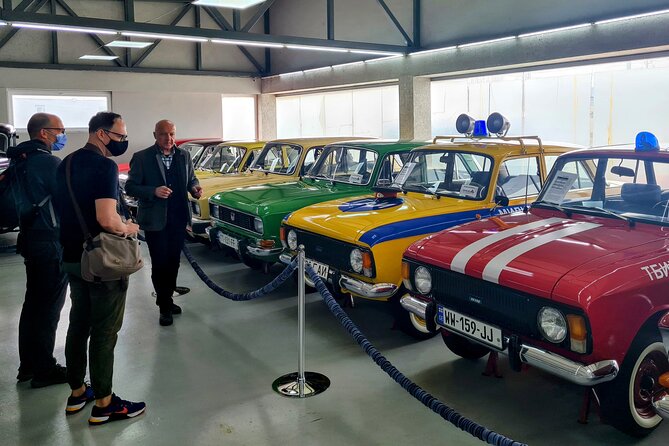
- A Soviet car museum option: One participant added this stop and found its restored cars and motorbikes a worthwhile extra, but confirm availability before booking.
Why Soviet Tbilisi works best as a moving tour
Tbilisi is not a city where every important Soviet-era site sits along one easy walking route. The buildings and monuments are scattered, and some are well outside the usual old-town circuit. An air-conditioned vehicle saves time and makes the day practical, especially in warm weather or when you want to cover more ground without spending your energy on taxis.
The tour is less about ticking off famous sights and more about seeing how Soviet ideas shaped public buildings, monuments, transport routes, and everyday life. You get architecture, political history, and modern Georgian context in the same outing.
That mix is the reason I would choose this experience after seeing Tbilisi’s old town. The traditional center gives you balconies, churches, sulfur baths, and narrow lanes. This tour shows another city, one built around state power, grand symbols, utilitarian design, and large-scale public projects.
Your guide is central to the experience. The named guides associated with past departures include Giorgi, Georgi, Irakli, David, and George. The strongest praise focuses on their ability to explain how architecture connects to Georgian and Soviet history, answer questions, and adjust the outing when a particular subject catches your interest.
more soviet-era sites to see
- 1 Day Private Armenia: UNESCO, Soviet & Curated Family Lunch
★ 5.0 · 106 reviews - Tbilisi old town & soviet heritage – Private driver-guided Tour
★ 5.0 · 83 reviews - Armenia: 1 Day Soviet gems, UNESCO + Family lunch (Small group)
★ 5.0 · 68 reviews
Starting at Rose Revolution Square
The meeting point is 2 Rose Revolution Square, a convenient central location near public transportation. You are not collected from your hotel, and the ride to the meeting point is your responsibility, so plan that part before the start time.
Once you meet the guide, the first portion is a broad tour of the less-visited side of Tbilisi. This opening drive is important because it gives the rest of the experience a wider frame. Instead of treating each building as an isolated curiosity, the guide can show how Soviet planning and monumental design appeared in different parts of the city.
The exact order can vary, and the first section is described as lasting about two hours. That is useful to know because this is not a quick photo stop tour. You spend time moving between sites and discussing the city’s architecture and political past.
The vehicle also makes it easier to reach sights spread across Tbilisi. You will not need to work out separate taxi rides between each stop, and the small group keeps the ride more relaxed than a full-size bus outing.
The Bank of Georgia’s stacked concrete puzzle
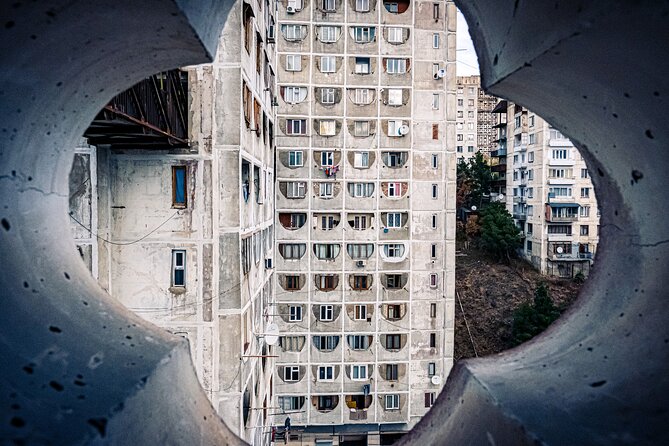
The head office of the Bank of Georgia is one of the tour’s best architectural surprises. It is frequently placed among the leading examples of Soviet architecture, and its form looks almost like a collection of large blocks set on top of one another.
The unusual shape was not simply an attempt to make an eye-catching office. It had a practical reason, and your guide can explain that connection while you look at the building. That detail matters because it turns an odd-looking structure into a lesson in how Soviet architects handled space, function, and visual power.
The visit is short, about 15 minutes, with no admission charge. That makes it a good stop for photographs and explanation rather than a long interior visit. You should not expect a full museum experience here. The value is in seeing the building in person and understanding why its design earns so much attention.
I especially like this stop for visitors who think Soviet architecture means only gray apartment blocks. The headquarters is bold, highly unusual, and difficult to understand fully from a photograph. It also provides a good contrast with the more symbolic monument that comes next.
The Chronicles of Georgia and its wide city views
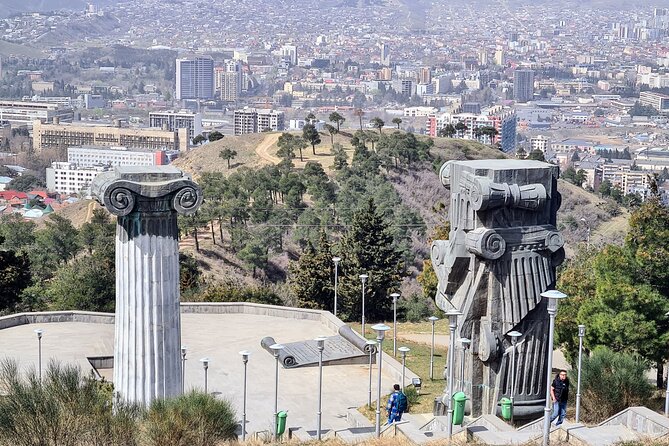
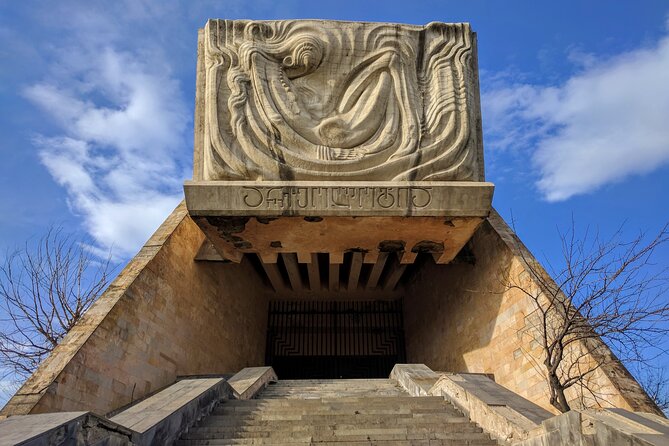
The Chronicles of Georgia is often called Tbilisi’s Stonehenge, though the comparison is mainly about scale and the arrangement of massive stone forms. It is a major example of Socialist monumentalism, with a strong visual presence and a setting that looks out toward the city’s outer districts.
The planned stop lasts about 30 minutes. That gives you time to study the monument, take photographs, and look across the surrounding area. The view is part of the appeal. You see a side of Tbilisi that feels distant from the polished center and helps explain the city’s spread beyond its historic core.
This is not a small decorative monument tucked into a quiet square. Its scale is the point. Soviet public art often aimed to make ideology feel permanent and physically imposing, and the Chronicles of Georgia lets you see that approach clearly.
I would bring practical footwear, even though the tour itself does not require strenuous walking. The site is open and exposed, and the experience is more enjoyable when you can move around comfortably rather than treating it as a single roadside photograph.
The half-hour stop is enough for most people, though anyone deeply interested in monumental sculpture may want more time. Since the group is small, ask the guide how much time is available on the day.
A different direction out of Tbilisi entirely:
- Day Trip to Kakheti Wine Region Including 9 Wine Tastings
★ 5.0 · 2,774 reviews - Highlights of Caucasus Mountains-Jinvali,Ananuri,Gudauri,Kazbegi(Group tour)
★ 5.0 · 2,682 reviews - Day Trip to Kazbegi and Gudauri
★ 5.0 · 2,009 reviews - Day Trip to Mtskheta Gori and Uplistsikhe
★ 5.0 · 1,801 reviews
Beneath the city at Stalin’s printing house
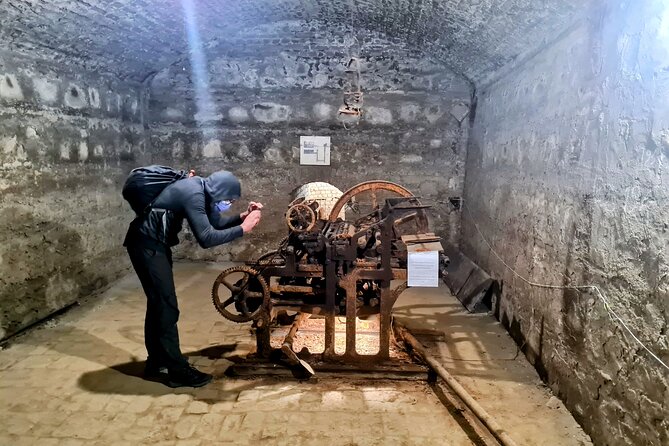
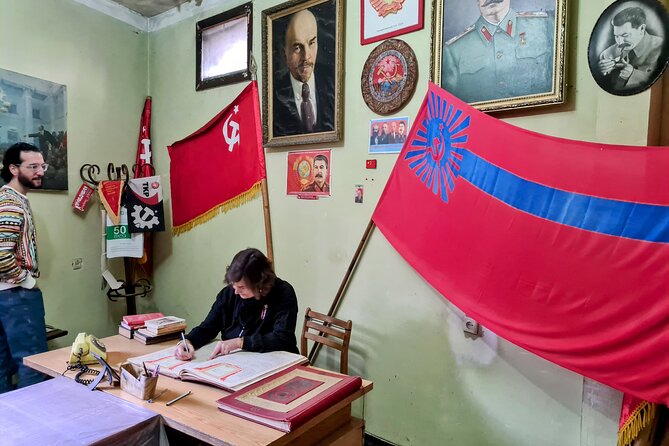
The most unusual stop is the J. Stalin Underground Printing House Museum. This concealed printing site is tied to Stalin and his supporters, who used it to make plans and produce propaganda leaflets.
Here, Soviet history becomes more physical. Instead of standing outside a monumental building, you enter a place connected with secret political work, underground organization, and the spread of printed messages. The setting gives the subject a sharper edge than a standard museum display.
The scheduled visit lasts about 40 minutes, and admission is included. That is enough time for the guide to explain the site and for you to take in its cramped, hidden character. The museum is a particularly good match for anyone interested in the mechanics of revolutionary movements, not only their public monuments.
The site also gives the tour a useful change of mood. The Bank of Georgia is a working architectural statement. The Chronicles of Georgia is a giant public monument. The printing house is concealed and functional. Together, the stops show three different ways political ideas can shape a city.
One especially strong version of this outing included introductions to historians connected with two of the sites. That kind of personal explanation can add a lot, but it should be treated as a possible feature of the guide and day rather than a fixed promise. The experience depends partly on who leads your departure and what access is available.
What guides add to the buildings
The buildings are interesting on their own, but the tour makes more sense when the guide connects design with daily life. Several guides have been praised for explaining how Soviet rule affected Georgia in both large public projects and small cultural details.
Giorgi has been described as bringing a steady flow of information and adding personal touches, including a special bean-filled khachapuri at the end of one outing. That food surprise is not listed as an included feature, so do not book expecting it. Still, it shows the kind of warm Georgian hospitality that can make a history tour feel less formal.
Irakli has been praised for answering questions and explaining Georgian history alongside the Soviet period. David has been noted for linking architecture to modern and historic Georgia. George has been credited with clear communication before the tour, flexibility during the outing, and dropping participants at a more useful location afterward.
Those details point to an important strength: this is not just a fixed audio script. The guide can shape the conversation around your interests. If you want to ask about architecture, propaganda, daily life, censorship, or Georgia’s relationship with the Soviet Union, a small group gives you a better chance to do so.
The quality will still depend on your individual guide. The repeated emphasis on guide service is encouraging, but you may receive a slightly different style from Giorgi, Irakli, David, or George. At booking, you can ask which guide is scheduled if that matters to you.
The optional Soviet car museum
An additional Soviet car museum stop has been taken by at least one group, with restored cars and motorbikes as the main attraction. It is a natural add-on for anyone who likes old vehicles, industrial design, or the everyday material culture of the Soviet period.
The important practical point is that this stop is not part of the listed core route. Treat it as an optional possibility and confirm the details with Real Georgia Tours before you book or before the day begins.
If you add it, allow more time. The standard route already includes several stops across the city, and the outing can run longer than the advertised three to four hours. For a visitor with a strong interest in Soviet objects, the museum could make the experience more varied. For someone mainly interested in architecture and political history, the four listed stops may be enough.
Is $99 a fair price?
At $99 per person, the tour is not the cheapest way to see Tbilisi. You are paying for a private-feeling small-group outing, an air-conditioned vehicle, a professional local guide, and admission to the underground printing house. Admission to the Bank of Georgia site and Chronicles of Georgia is free, but reaching those scattered locations independently would still take time and transport planning.
The maximum group size of six is the biggest part of the value. You avoid the impersonal feel of a large coach, and you can ask questions without waiting for a long line of people to finish. If the guide is as engaged and flexible as the strongest departures suggest, that personal attention helps justify the price.
The value is also higher if you have only a short stay in Tbilisi. In one half-day, you cover several distant places and receive a connected explanation rather than piecing the story together from separate taxi rides and brief internet searches.
The price is harder to justify if you are happy using local transport, already know Soviet history well, or mainly want free outdoor sights. In that case, the guided interpretation and convenience are the main reasons to pay.
Group discounts are available, though the specific discount is not stated. Ask about the current rate if you are booking with several people.
Timing, comfort, and practical limits
The listed duration is approximately three to four hours. One actual outing lasted about five hours, with five Soviet-related places and extra historical conversations. I would plan for the longer possibility, especially if you are booking a restaurant, train, flight, or another timed activity afterward.
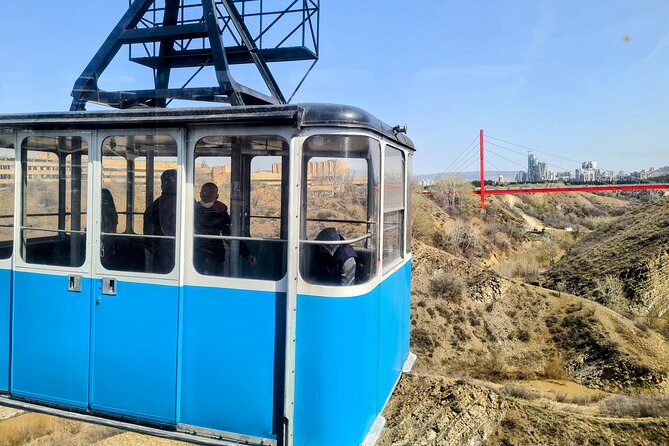
The vehicle is air-conditioned, which matters during hot Tbilisi weather and on a route that crosses different parts of the city. The vehicle also reduces the need for repeated taxi arrangements.
The experience is offered in English and uses a mobile ticket. Confirmation is received when you book, and the activity returns to the original meeting point. One guide has dropped participants somewhere more convenient at the end, but that appears to be a courtesy rather than a guaranteed part of the service.
Most people can take part, and the tour is near public transportation. The information provided does not give a detailed accessibility description, so contact the operator if you need specific help with steps, underground access, or walking conditions.
Free cancellation is available until 24 hours before the start time. Cancellations or changes made inside that window are not refunded or accepted, based on the local start time.
Who should book this Tbilisi history tour?
I would choose it if you have already seen the old town and want a more unusual side of Tbilisi. It suits anyone interested in Soviet architecture, political history, propaganda, urban design, or the way Georgia’s past still shapes its public spaces.
It is also a good choice for first-time visitors who want a guide to handle the geography. The sites are spread out, and the vehicle lets you spend your time looking and listening instead of arranging transport.
You may want to skip it if your priority is a relaxed food tour, a classic walking route, or a packed schedule with no room for the timing to stretch. This is an idea-led experience, not a quick collection of postcard sights.
Should you book Soviet Tour: Hidden Tbilisi?
Book it if you want to understand Tbilisi beyond its old churches and balconies. The Bank of Georgia, Chronicles of Georgia, and underground printing house give you three very different views of the Soviet period, while a small group and a local guide make the subject easier to discuss.
Before paying, allow up to five hours, confirm the meeting point, ask which guide is scheduled, and check whether the Soviet car museum can be added. At $99, the tour earns its price through transport, access, and personal explanation rather than through entrance fees alone. For curious visitors who value context and unusual places, that is a fair trade.
FAQ
How long does Soviet Tour: Hidden Tbilisi last?
The stated duration is approximately three to four hours. One outing lasted about five hours, so you should leave extra time in your schedule.
Where does the tour start and finish?
It starts at 2 Rose Revolution Square, Tbilisi 0108, Georgia, and ends back at the meeting point.
How many people can join the tour?
The activity has a maximum of six participants.
Is transportation to the meeting point included?
No. Transport to and from the meeting point is not included, though the tour itself uses an air-conditioned vehicle.
Is the tour offered in English?
Yes. The tour is offered in English.
What is the cancellation policy?
You can cancel at least 24 hours before the local start time for a full refund. Cancellations or changes made less than 24 hours before the start time are not accepted or refunded.
Recently added around Tbilisi
- 2-Day Private Wine Tour to Kakheti from Tbilisi★ 5.0 · 3 reviews
- Kakheti wine region – Private Tour★ 5.0 · 3 reviews
- 17 Day Private Tour through Georgia★ 5.0 · 3 reviews
- Tbilisi and Mtskheta cities private, cultural tour★ 5.0 · 3 reviews
- Tbilisi City Tour with Street Photography★ 5.0 · 3 reviews
- Kakheti With Top Destinations★ 5.0 · 3 reviews
- Tbilisi City, Jvari Monastery, Uplistsikhe caves, Mtskheta city Private Day Trip★ 4.5 · 3 reviews
- Jvari monastery & Mtskheta – Half day group tour from Tbilisi★ 5.0 · 3 reviews
Tbilisi Tours, compared.

Day Trip to Kakheti Wine Region Including 9 Wine Tastings
Read our review →
Highlights of Caucasus Mountains-Jinvali,Ananuri,Gudauri,Kazbegi(Group tour)
Read our review →

Tbilisi Walking Tour Including Cable Car and Traditional Bakery
Read our review →

Kakheti Wine Region: Signagi and Bodbe Tour with 10 Wine Tastings
Read our review →
Mtskheta,Jvari,Bazaar,wine tasting,Chronicles of Georgia
Read our review →Browse the lists this tour appears in