

Reviewed · TBILISI TOURS
Very Friendly Tbilisi Walking Tour (wine tasting & cable car)
Tbilisi reveals itself best on foot, one crooked lane and weathered church at a time. This four-hour tour links the city’s main sights with details you could easily miss alone, from an 11th-century city wall to a tiny waterfall and the clockwork angel above Rezo Gabriadze’s theater.
I like the small-group format, listed at up to 15 people, and the easy mix of walking, history, city views, and the included cable-car ride. I also like the chance to see both famous sights and everyday corners, including the sulfur-bath district and Meidan Bazaar.
The main thing to check before paying is the wine tasting. It appears in the tour name, but the supplied details do not explain where it happens, how much wine is served, or whether it is included. Hotel pickup is also described as available in one place but not included elsewhere, so confirm both points.
Key points to know before you book
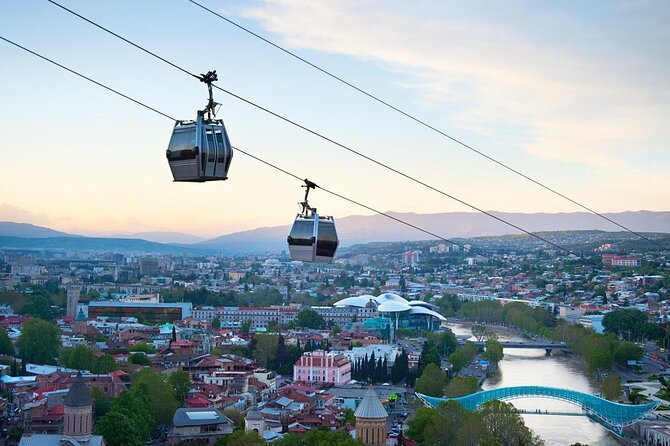
- Four hours on foot: Expect a steady Old Tbilisi walking route with about 16 listed stops, plus the cable car.
- A useful first look at the city: The route covers churches, bridges, fortifications, markets, baths, and viewpoints.
- Cable car included: The ride links Rike Park with Narikala Fortress and saves a steep uphill climb.
- Small-group promise: The tour is presented as a maximum of 15 people, though the booking information also gives a broader maximum of 100 for the activity.
- Friendly guide style: Guide Anastasia de Fellini is specifically named in the available feedback and is described as warm, personal, and enthusiastic about her work.
- Clarify the extras: Bottled water and a local guide are included. Food, drinks, hotel pickup, and drop-off are not clearly included.
What this Tbilisi walk does well
At $27.24 per person, this is priced as an affordable introduction to Tbilisi rather than a full-day cultural study. You get a local guide, bottled water, entry to the cable car, and a route that covers much of the historic center in roughly four hours.
I see the value in the route’s variety. One hour might bring you to a sixth-century basilica, while the next takes you across a modern glass bridge or into a lane lined with sulfur baths. That contrast is one of Tbilisi’s defining pleasures, and the tour puts it in front of you without requiring separate planning.
The walk also helps with orientation. Pushkin Square is the starting point, and the route eventually reaches Orbeliani Square near Orbeliani Bazaar. You finish in a useful central area, not far from shops and places to eat.
The walking pace is the point, but it is also the main physical consideration. The route includes uneven historic streets, the Narikala area, and a waterfall path. Most people can take part, but comfortable shoes will matter more than stylish ones.
more wine tastings around Tbilisi
- Day Trip to Kakheti Wine Region Including 9 Wine Tastings
★ 5.0 · 2,774 reviews - Kakheti Wine Region: Signagi and Bodbe Tour with 10 Wine Tastings
★ 5.0 · 1,019 reviews - Tbilisi:Mtskheta,Jvari,Bazaar,wine tasting,Chronicles of Georgia
★ 5.0 · 730 reviews
From Pushkin Square to Tbilisi’s oldest layers
The tour begins at Tbilisi Pushkin Square. From there, the first stop is the remains of the city wall and underground heritage linked to the 11th century, including an old customs gate.
You only spend about 15 minutes here, but this is a useful opening. It reminds you that Tbilisi was not built as a neat modern grid. The city grew through layers of trade, defense, religion, and empire.
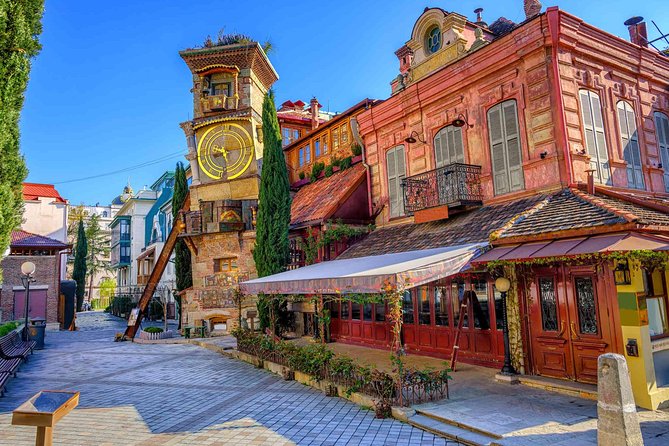
Next comes Rezo Gabriadze Marionette Theater on Shavteli Street. The theater dates to 1981 and was created by Georgian artist Rezo Gabriadze. Its fanciful clock tower, added in 2010, is one of Old Tbilisi’s most photographed sights.
Try to time your stop around the hour. A golden angel appears from a painted doorway and rings a bell with a small hammer. The stop lasts only 15 minutes, so you may not catch the performance, but the guide can explain what you are seeing and point out the theater’s unusual design.
Anchiskhati Basilica follows. Dating to the sixth century, it is the oldest church building in Tbilisi. Its name is tied to the Savior icon brought from Anchi Monastery in 1664, an object now kept in the Georgian National Museum.
You get about 10 minutes here. That is enough for a quick look and some context, but not a long church visit. If religious art and Georgian church architecture are a major reason for your visit, you may want to return later at a slower pace.
Palaces, churches, and the modern Peace Bridge
The route continues to the Georgian Patriarchate and its seminary building on Erekle II Square. The site once held the palace of King Rostom. The present building began in 1809 on the remains of that palace and later became a center for the Russian Orthodox Church administration.
This stop is short, around 10 minutes, and is more about setting than interior access. You see how Tbilisi’s religious and political story changed under Russian imperial rule.
Then the city shifts sharply in style at the Bridge of Peace. Opened in 2010, this curving pedestrian bridge crosses the Mtkvari River between Erekle II Street and Rike Park. Its glass and steel design has become one of the symbols of modern Tbilisi.
I like having this bridge on an old-city route. It prevents the tour from treating Tbilisi as a museum frozen in the past. You see the older riverbanks, then cross a very modern structure designed by Michele de Luca, with lighting by Philippe Martino.
Rike Park takes about 15 minutes. The park is known for its planned shape, including pathways said to form a map of Georgia when viewed from above. It is also the departure point for the cable car, so this stop leads naturally to the next part of the tour.
The cable car to Narikala Fortress

The Tbilisi Aerial Tramway connects Rike Park, or Europe Square, with Narikala Fortress. The cable-car ticket is included, which is an important value point because it replaces a climb and gives you a fine view over the Mtkvari and the old city.
The ride itself is listed at about 10 minutes. That is not long, but it changes the rhythm of the tour. After walking through lanes and squares, you rise above the rooftops and arrive near the fortress and Mother of Kartli.
At the top, you visit Kartlis Deda, the Mother of Georgia statue. She holds a wine cup for friends and a sword for enemies, a simple image of Georgian hospitality and defense. It is a quick 10-minute stop, but the statue helps explain a national symbol without turning the tour into a lecture.
Narikala Fortress gets about 20 minutes. Its origins reach back to the fourth century, and Arab rulers expanded it in the seventh and eighth centuries. The remaining walls sit on Mtatsminda above the city, with the small Saint Nicholas Church on the grounds.
Do not expect to explore every corner in 20 minutes. This is a compact visit focused on the setting, the remains, and the views. If you want extensive time inside the fortress, take note of the tour’s fixed schedule and consider returning independently.
more days out of Tbilisi to compare
- Old Tbilisi Tour: Private Walking Tour With Wine Tasting
★ 5.0 · 273 reviews - Private Tbilisi Food Tour: 9 Tastings Walk in Bohemian District
★ 5.0 · 227 reviews - Tbilisi Food Tour in a Local Family
★ 5.0 · 113 reviews - Private Wine Tasting in Prince Karalashvili Wine Cellar. Tbilisi
★ 5.0 · 63 reviews
Down through the mosque, waterfall, and sulfur baths
The route then brings you toward Tbilisi Mosque, also called Juma Mosque, below Narikala. It is currently the city’s only Muslim shrine. The first Sunni mosque on this site was built in the eighteenth century, destroyed by the Persians, and rebuilt in the nineteenth century.
This is one of the route’s more valuable cultural stops because it adds a part of Tbilisi often missed on a quick central-city walk. The tour information does not promise an interior visit, so treat it as an exterior and neighborhood stop unless your guide says otherwise.
Leghvtakhevi Waterfall is next. The 22-meter waterfall sits in the old city, in the Abanotubani area. Its name comes from the Georgian word for fig, reflecting the fig trees that once grew around the gorge.
The waterfall is a welcome change from monuments and formal squares. The walk to it may involve a narrower path and uneven ground, so keep your footing and avoid carrying anything cumbersome.
Abanotubani is the sulfur-bath district at the foot of Narikala. Hot sulfur springs made this area important, and the baths were built at different times from roughly the seventeenth through nineteenth centuries.
You spend around 30 minutes in the district, the longest stop on the route. That gives the guide time to explain how the springs shaped this part of the city and to point out Chreli Abano, the colorful bathhouse that can look like a mosque from the outside.
A bath is not included. Food and drinks are not included either, so plan this tour as sightseeing rather than a bathing session or tasting meal. If you want to book a sulfur bath, treat it as a separate activity and arrange it for another time unless the operator confirms otherwise.
Meidan Bazaar and the old city’s social streets

Meidan Bazaar is a natural place to slow down and look at local products. The square has long served as a commercial center, with earlier names including Shaitan Bazaar and Tatris Moedani. It was also noted by French traveler Jean Chardin in the eighteenth century.
You have about 20 minutes here. That is enough for browsing, but not necessarily enough for serious shopping. The bazaar offers traditional Georgian wine, handmade accessories, souvenirs, and local foods.
This is also the point where the wine-tasting question matters most. The tour title includes wine tasting, but the detailed schedule only identifies Meidan Bazaar as a place to buy wine and other goods. Ask specifically if a tasting is included, or budget for purchases separately.
Jan Shardeni Street follows. This pedestrian lane and its nearby streets, including Bambis Rigi, Rkinis Rigi, and Erekle II Street, form one of the central social areas in Old Tbilisi. Galleries and cafes line the route.
The area can feel more polished and commercial than the quieter lanes near the churches. That is not a flaw, but it is worth knowing. You get a quick look at the city’s cafe and gallery scene, not an intimate neighborhood visit.
Sioni Cathedral and the finish near Orbeliani Bazaar

The final listed sight is Sioni Cathedral, a cross-domed Georgian church on the lower bank of the Mtkvari. It served as Tbilisi’s cathedral for centuries and became the Patriarchal Cathedral in 1920.
The stop lasts about 10 minutes. As with Anchiskhati Basilica, this is a concise introduction rather than a detailed religious-art visit. Dress and behavior should be respectful in any active church, and your guide can help with local customs.
The tour ends at Orbeliani Square, near Orbeliani Bazaar. This is a practical finish because you can continue exploring, find food, or use public transport from the central area.
The route is arranged as a one-way introduction, not a return-to-start loop. That means you should avoid leaving anything at the meeting point, since hotel drop-off is not included.
Guide quality and group size

The strongest personal detail available about the guiding comes from Anastasia de Fellini, who is described as very friendly, close with guests, and clearly fond of her work. That matters on a history-heavy walk. A warm guide can turn a list of dates into a conversation about Georgian identity, faith, food, and city life.
The tour is promoted as a small-group experience with a maximum of 15 people. That size should make it easier to hear the guide and ask questions, especially in narrow streets or around busy sights.
One practical inconsistency deserves attention. The additional booking information gives a maximum of 100 participants for the activity. That may refer to the wider booking capacity rather than each walking group, but you should confirm the actual group size for your date if a personal tour is important to you.
Hotel pickup is another point to clarify. The highlights say hassle-free pickup is available, while the inclusion section says hotel pickup and drop-off are not included. The listed starting point is Pushkin Square, so plan to meet there unless the operator confirms a separate pickup arrangement.
Who will get the most from this tour
I would choose this walk for a first stay in Tbilisi, especially if you want a clear introduction before exploring on your own. It covers enough ground to show how the city fits together: the river, old churches, fortress, baths, markets, and modern public spaces.
It also suits people who prefer a guide to provide context rather than spending time researching every monument. The route is broad, and the guide’s local perspective can help you decide where to return later.
Families can join because children must be accompanied by an adult, and most people can participate. Service animals are allowed, and the route is near public transportation.
I would be more cautious if you dislike walking, need long visits at each sight, or want a dedicated food-and-wine experience. Four hours and many stops mean short visits. You see a lot, but you will not linger everywhere.
Price, timing, and what to confirm
At $27.24, the tour offers solid value if the cable-car ride and guide are your main priorities. You are paying for a planned route through the historic center, local explanation, bottled water, and transport up to Narikala, not for meals, museum admission, or a long private tour.
The experience is commonly booked about 14 days ahead. That is useful planning information if your dates are fixed, though it does not guarantee that every date will sell out.
Mobile tickets are available, group discounts are offered, and confirmation arrives at booking. Free cancellation is available up to 24 hours before the start time. If the minimum number of participants is not reached and the tour is canceled, you are offered another date or experience, or a full refund.
Before booking, I would ask three direct questions:
- Is wine tasting included in the $27.24 price?
- Is hotel pickup actually available, and does it cost extra?
- Will my departure run with a group of 15 or fewer?
Should you book the Very Friendly Tbilisi Walking Tour?
Book it if you want a reasonably priced first look at Tbilisi with a local guide, a strong mix of major sights, and a cable-car ride built into the route. The visit to Narikala, the sulfur-bath district, the oldest churches, and the modern Peace Bridge gives you a useful sense of the capital’s many eras.
I would not book it solely for wine tasting until that detail is confirmed. If the tasting is included, it improves the value. If not, this remains a solid city orientation walk, but you should think of the bazaar as a shopping stop rather than a wine experience.
FAQ
How long does the Tbilisi walking tour last?
The tour lasts approximately four hours.
Where does the tour start?
The listed starting point is Tbilisi Pushkin Square in Tbilisi, Georgia.
Where does the tour end?
The tour ends at Orbeliani Square, near Orbeliani Bazaar.
Is the cable-car ride included?
Yes. The Tbilisi Aerial Tramway ticket is listed as included.
Is wine tasting included?
The tour title refers to wine tasting, but the supplied details do not clearly state where the tasting takes place or confirm that it is included. Ask the provider before booking.
Is hotel pickup included?
Hotel pickup is not included in the inclusion list. The highlights say pickup is available, so confirm whether it can be arranged and whether an extra charge applies.
How large is the group?
The tour is described as a small-group experience with a maximum of 15 people. The additional booking information also lists a maximum of 100 for the activity, so confirm the group size for your date.
What is included in the price?
A local guide, bottled water, and the cable-car admission are included.
Are food and drinks included?
No. Food and drinks are listed as not included.
Can children join the tour?
Yes. Children must be accompanied by an adult.
Can I cancel for a full refund?
Yes, if you cancel at least 24 hours before the experience start time. Cancellations or changes made less than 24 hours before the start time are not refunded or accepted.
More Walking Tours in Tbilisi
- Tbilisi Walking Tour Including Cable Car and Traditional Bakery
★ 5.0 · 1,310 reviews - Tbilisi:Evening Walking & Talking Tour with Wine & Boat Ride
★ 5.0 · 572 reviews - Old Tbilisi Highlights walking tour with wine & 10 tastings
★ 5.0 · 276 reviews - Tbilisi Old Town Walking Tour with a Local Guide
★ 5.0 · 168 reviews
Recently added around Tbilisi
- 2-Day Private Wine Tour to Kakheti from Tbilisi★ 5.0 · 3 reviews
- Kakheti wine region – Private Tour★ 5.0 · 3 reviews
- 17 Day Private Tour through Georgia★ 5.0 · 3 reviews
- Tbilisi and Mtskheta cities private, cultural tour★ 5.0 · 3 reviews
- Tbilisi City Tour with Street Photography★ 5.0 · 3 reviews
- Kakheti With Top Destinations★ 5.0 · 3 reviews
- Jvari monastery & Mtskheta – Half day group tour from Tbilisi★ 5.0 · 3 reviews
- Tbilisi City, Jvari Monastery, Uplistsikhe caves, Mtskheta city Private Day Trip★ 4.5 · 3 reviews
Tbilisi Tours, compared.
Day Trip to Kakheti Wine Region Including 9 Wine Tastings
Read our review →
Highlights of Caucasus Mountains-Jinvali,Ananuri,Gudauri,Kazbegi(Group tour)
Read our review →

Tbilisi Walking Tour Including Cable Car and Traditional Bakery
Read our review →

Kakheti Wine Region: Signagi and Bodbe Tour with 10 Wine Tastings
Read our review →
Mtskheta,Jvari,Bazaar,wine tasting,Chronicles of Georgia
Read our review →Browse the lists this tour appears in